skip to main |
skip to sidebar

Genesis 36
Descendants of Esau
1This is the history of the descendants of Esau (also known as Edom). 2Esau married two young women from Canaan: Adah, the daughter of Elon the Hittite; and Oholibamah, the daughter of Anah and granddaughter of Zibeon the Hivite. 3He also married his cousin Basemath, who was the daughter of Ishmael and the sister of Nebaioth. 4Esau and Adah had a son named Eliphaz. Esau and Basemath had a son named Reuel. 5Esau and Oholibamah had sons named Jeush, Jalam, and Korah. All these sons were born to Esau in the land of Canaan.
6Then Esau took his wives, children, household servants, cattle, and flocks--all the wealth he had gained in the land of Canaan--and moved away from his brother, Jacob. 7There was not enough land to support them both because of all their cattle and livestock. 8So Esau (also known as Edom) settled in the hill country of Seir.
9This is a list of Esau's descendants, the Edomites, who lived in the hill country of Seir.
10Among Esau's sons were Eliphaz, the son of Esau's wife Adah; and Reuel, the son of Esau's wife Basemath.
11The sons of Eliphaz were Teman, Omar, Zepho, Gatam, and Kenaz. 12Eliphaz had another son named Amalek, born to Timna, his concubine. These were all grandchildren of Esau's wife Adah.
13The sons of Reuel were Nahath, Zerah, Shammah, and Mizzah. These were all grandchildren of Esau's wife Basemath.
14Esau also had sons through Oholibamah, the daughter of Anah and granddaughter of Zibeon. Their names were Jeush, Jalam, and Korah.
15Esau's children and grandchildren became the leaders of different clans.
The sons of Esau's oldest son, Eliphaz, became the leaders of the clans of Teman, Omar, Zepho, Kenaz, 16Korah, Gatam, and Amalek. These clans in the land of Edom were descended from Eliphaz, the son of Esau and Adah.
17The sons of Esau's son Reuel became the leaders of the clans of Nahath, Zerah, Shammah, and Mizzah. These clans in the land of Edom were descended from Reuel, the son of Esau and Basemath.
18The sons of Esau and his wife Oholibamah became the leaders of the clans of Jeush, Jalam, and Korah. These are the clans descended from Esau's wife Oholibamah, the daughter of Anah.
19These are all the clans descended from Esau (also known as Edom).
Original Peoples of Edom
20These are the names of the tribes that descended from Seir the Horite, one of the families native to the land of Seir: Lotan, Shobal, Zibeon, Anah, 21Dishon, Ezer, and Dishan. These were the Horite clans, the descendants of Seir, who lived in the land of Edom.
22The sons of Lotan were Hori and Heman. Lotan's sister was named Timna.
23The sons of Shobal were Alvan, Manahath, Ebal, Shepho, and Onam.
24The sons of Zibeon were Aiah and Anah. This is the Anah who discovered the hot springs in the wilderness while he was grazing his father's donkeys.
25The son of Anah was Dishon, and Oholibamah was his daughter.
26The sons of Dishon[a] were Hemdan, Eshban, Ithran, and Keran.
27The sons of Ezer were Bilhan, Zaavan, and Akan.
28The sons of Dishan were Uz and Aran.
29So the leaders of the Horite clans were Lotan, Shobal, Zibeon, Anah, 30Dishon, Ezer, and Dishan. The Horite clans are named after their clan leaders, who lived in the land of Seir.
Rulers of Edom
31These are the kings who ruled in Edom before there were kings in Israel[b]:
32Bela son of Beor, who ruled from his city of Dinhabah.
33When Bela died, Jobab son of Zerah from Bozrah became king.
34When Jobab died, Husham from the land of the Temanites became king.
35When Husham died, Hadad son of Bedad became king and ruled from the city of Avith. He was the one who destroyed the Midianite army in the land of Moab.
36When Hadad died, Samlah from the city of Masrekah became king.
37When Samlah died, Shaul from the city of Rehoboth on the Euphrates River[c] became king.
38When Shaul died, Baal-hanan son of Acbor became king.
39When Baal-hanan died, Hadad[d] became king and ruled from the city of Pau. Hadad's wife was Mehetabel, the daughter of Matred and granddaughter of Me-zahab.
40These are the leaders of the clans of Esau, who lived in the places named for them: Timna, Alvah, Jetheth, 41Oholibamah, Elah, Pinon, 42Kenaz, Teman, Mibzar, 43Magdiel, and Iram. These are the names of the clans of Esau, the ancestor of the Edomites, each clan giving its name to the area it occupied.
Footnotes:
Genesis 36:26 Hebrew Dishan, a variant name for Dishon; compare 36:21, 28.
Genesis 36:31 Or before an Israelite king ruled over them.
Genesis 36:37 Hebrew the river.
Genesis 36:39 As in some Hebrew manuscripts, Samaritan Pentateuch, and Syriac version (see also 1 Chr 1:50); most Hebrew manuscripts read Hadar.

Genesis 32
Jacob Sends Gifts to Esau
1As Jacob and his household started on their way again, angels of God came to meet him. 2When Jacob saw them, he exclaimed, "This is God's camp!" So he named the place Mahanaim.[a]
3Jacob now sent messengers to his brother, Esau, in Edom, the land of Seir. 4He told them, "Give this message to my master Esau: `Humble greetings from your servant Jacob! I have been living with Uncle Laban until recently, 5and now I own oxen, donkeys, sheep, goats, and many servants, both men and women. I have sent these messengers to inform you of my coming, hoping that you will be friendly to us.' "
6The messengers returned with the news that Esau was on his way to meet Jacob--with an army of four hundred men! 7Jacob was terrified at the news. He divided his household, along with the flocks and herds and camels, into two camps. 8He thought, "If Esau attacks one group, perhaps the other can escape."
9Then Jacob prayed, "O God of my grandfather Abraham and my father, Isaac--O LORD, you told me to return to my land and to my relatives, and you promised to treat me kindly. 10I am not worthy of all the faithfulness and unfailing love you have shown to me, your servant. When I left home, I owned nothing except a walking stick, and now my household fills two camps! 11O LORD, please rescue me from my brother, Esau. I am afraid that he is coming to kill me, along with my wives and children. 12But you promised to treat me kindly and to multiply my descendants until they become as numerous as the sands along the seashore--too many to count."
13Jacob stayed where he was for the night and prepared a present for Esau: 14two hundred female goats, twenty male goats, two hundred ewes, twenty rams, 15thirty female camels with their young, forty cows, ten bulls, twenty female donkeys, and ten male donkeys. 16He told his servants to lead them on ahead, each group of animals by itself, separated by a distance in between.
17He gave these instructions to the men leading the first group: "When you meet Esau, he will ask, `Where are you going? Whose servants are you? Whose animals are these?' 18You should reply, `These belong to your servant Jacob. They are a present for his master Esau! He is coming right behind us.' " 19Jacob gave the same instructions to each of the herdsmen and told them, "You are all to say the same thing to Esau when you see him. 20And be sure to say, `Your servant Jacob is right behind us.' " Jacob's plan was to appease Esau with the presents before meeting him face to face. "Perhaps," Jacob hoped, "he will be friendly to us." 21So the presents were sent on ahead, and Jacob spent that night in the camp.
Jacob Wrestles with God
22But during the night Jacob got up and sent his two wives, two concubines, and eleven sons across the Jabbok River. 23After they were on the other side, he sent over all his possessions. 24This left Jacob all alone in the camp, and a man came and wrestled with him until dawn. 25When the man saw that he couldn't win the match, he struck Jacob's hip and knocked it out of joint at the socket. 26Then the man said, "Let me go, for it is dawn."
But Jacob panted, "I will not let you go unless you bless me."
27"What is your name?" the man asked.
He replied, "Jacob."
28"Your name will no longer be Jacob," the man told him. "It is now Israel,[b] because you have struggled with both God and men and have won."
29"What is your name?" Jacob asked him.
"Why do you ask?" the man replied. Then he blessed Jacob there.
30Jacob named the place Peniel--"face of God"--for he said, "I have seen God face to face, yet my life has been spared." 31The sun rose as he left Peniel,[c] and he was limping because of his hip. 32That is why even today the people of Israel don't eat meat from near the hip, in memory of what happened that night.
Footnotes:
Genesis 32:2 Mahanaim means "two camps."
Genesis 32:28 Israel means "God struggles" or "one who struggles with God."
Genesis 32:31 Hebrew Penuel, a variant name for Peniel.
Genesis 33
Jacob and Esau Make Peace
1Then, in the distance, Jacob saw Esau coming with his four hundred men. 2Jacob now arranged his family into a column, with his two concubines and their children at the front, Leah and her children next, and Rachel and Joseph last. 3Then Jacob went on ahead. As he approached his brother, he bowed low seven times before him. 4Then Esau ran to meet him and embraced him affectionately and kissed him. Both of them were in tears.
5Then Esau looked at the women and children and asked, "Who are these people with you?"
"These are the children God has graciously given to me," Jacob replied. 6Then the concubines came forward with their children and bowed low before him. 7Next Leah came with her children, and they bowed down. Finally, Rachel and Joseph came and made their bows.
8"And what were all the flocks and herds I met as I came?" Esau asked.
Jacob replied, "They are gifts, my lord, to ensure your goodwill."
9"Brother, I have plenty," Esau answered. "Keep what you have."
10"No, please accept them," Jacob said, "for what a relief it is to see your friendly smile. It is like seeing the smile of God! 11Please take my gifts, for God has been very generous to me. I have more than enough." Jacob continued to insist, so Esau finally accepted them.
12"Well, let's be going," Esau said. "I will stay with you and lead the way."
13But Jacob replied, "You can see, my lord, that some of the children are very young, and the flocks and herds have their young, too. If they are driven too hard, they may die. 14So go on ahead of us. We will follow at our own pace and meet you at Seir."
15"Well," Esau said, "at least let me leave some of my men to guide and protect you."
"There is no reason for you to be so kind to me," Jacob insisted.
16So Esau started back to Seir that same day. 17Meanwhile, Jacob and his household traveled on to Succoth. There he built himself a house and made shelters for his flocks and herds. That is why the place was named Succoth.[a] 18Then they arrived safely at Shechem, in Canaan, and they set up camp just outside the town. 19Jacob bought the land he camped on from the family of Hamor, Shechem's father, for a hundred pieces of silver.[b] 20And there he built an altar and called it El-Elohe-Israel.[c]
Footnotes:
Genesis 33:17 Succoth means "shelters."
Genesis 33:19 Hebrew 100 kesitahs; the value or weight of the kesitah is no longer known.
Genesis 33:20 El-Elohe-Israel means "God, the God of Israel."
Genesis 34
Revenge against Shechem
1One day Dinah, Leah's daughter, went to visit some of the young women who lived in the area. 2But when the local prince, Shechem son of Hamor the Hivite, saw her, he took her and raped her. 3But Shechem's love for Dinah was strong, and he tried to win her affection. 4He even spoke to his father about it. "Get this girl for me," he demanded. "I want to marry her."
5Word soon reached Jacob that his daughter had been defiled, but his sons were out in the fields herding cattle so he did nothing until they returned. 6Meanwhile, Hamor, Shechem's father, came out to discuss the matter with Jacob. 7He arrived just as Jacob's sons were coming in from the fields. They were shocked and furious that their sister had been raped. Shechem had done a disgraceful thing against Jacob's family,[a] a thing that should never have been done.
8Hamor told Jacob and his sons, "My son Shechem is truly in love with your daughter, and he longs for her to be his wife. Please let him marry her. 9We invite you to let your daughters marry our sons, and we will give our daughters as wives for your young men. 10And you may live among us; the land is open to you! Settle here and trade with us. You are free to acquire property among us."
11Then Shechem addressed Dinah's father and brothers. "Please be kind to me, and let me have her as my wife," he begged. "I will give whatever you require. 12No matter what dowry or gift you demand, I will pay it--only give me the girl as my wife."
13But Dinah's brothers deceived Shechem and Hamor because of what Shechem had done to their sister. 14They said to them, "We couldn't possibly allow this, because you aren't circumcised. It would be a disgrace for her to marry a man like you! 15But here is a solution. If every man among you will be circumcised like we are, 16we will intermarry with you and live here and unite with you to become one people. 17Otherwise we will take her and be on our way."
18Hamor and Shechem gladly agreed, 19and Shechem lost no time in acting on this request, for he wanted Dinah desperately. Shechem was a highly respected member of his family, 20and he appeared with his father before the town leaders to present this proposal. 21"Those men are our friends," they said. "Let's invite them to live here among us and ply their trade. For the land is large enough to hold them, and we can intermarry with them. 22But they will consider staying here only on one condition. Every one of us men must be circumcised, just as they are. 23But if we do this, all their flocks and possessions will become ours. Come, let's agree to this so they will settle here among us."
24So all the men agreed and were circumcised. 25But three days later, when their wounds were still sore, two of Dinah's brothers, Simeon and Levi, took their swords, entered the town without opposition, and slaughtered every man there, 26including Hamor and Shechem. They rescued Dinah from Shechem's house and returned to their camp. 27Then all of Jacob's sons plundered the town because their sister had been defiled there. 28They seized all the flocks and herds and donkeys--everything they could lay their hands on, both inside the town and outside in the fields. 29They also took all the women and children and wealth of every kind.
30Afterward Jacob said to Levi and Simeon, "You have made me stink among all the people of this land--among all the Canaanites and Perizzites. We are so few that they will come and crush us. We will all be killed!"
31"Should he treat our sister like a prostitute?" they retorted angrily.
Footnotes:
Genesis 34:7 Hebrew in Israel.
Genesis 35
Jacobs Return to Bethel
1God said to Jacob, "Now move on to Bethel and settle there. Build an altar there to worship me--the God who appeared to you when you fled from your brother, Esau."
2So Jacob told everyone in his household, "Destroy your idols, wash yourselves, and put on clean clothing. 3We are now going to Bethel, where I will build an altar to the God who answered my prayers when I was in distress. He has stayed with me wherever I have gone."
4So they gave Jacob all their idols and their earrings, and he buried them beneath the tree near Shechem. 5When they set out again, terror from God came over the people in all the towns of that area, and no one attacked them. 6Finally, they arrived at Luz (now called Bethel) in Canaan. 7Jacob built an altar there and named it El-bethel,[a] because God had appeared to him there at Bethel when he was fleeing from Esau.
8Soon after this, Rebekah's old nurse, Deborah, died. She was buried beneath the oak tree in the valley below Bethel. Ever since, the tree has been called the "Oak of Weeping."[b]
9God appeared to Jacob once again when he arrived at Bethel after traveling from Paddan-aram. God blessed him 10and said, "Your name is no longer Jacob; you will now be called Israel."[c] 11Then God said, "I am God Almighty. Multiply and fill the earth! Become a great nation, even many nations. Kings will be among your descendants! 12And I will pass on to you the land I gave to Abraham and Isaac. Yes, I will give it to you and your descendants." 13Then God went up from the place where he had spoken to Jacob.
14Jacob set up a stone pillar to mark the place where God had spoken to him. He then poured wine over it as an offering to God and anointed the pillar with olive oil. 15Jacob called the place Bethel--"house of God"--because God had spoken to him there.
The Deaths of Rachel and Isaac
16Leaving Bethel, they traveled on toward Ephrath (that is, Bethlehem). But Rachel's pains of childbirth began while they were still some distance away. 17After a very hard delivery, the midwife finally exclaimed, "Don't be afraid--you have another son!" 18Rachel was about to die, but with her last breath she named him Ben-oni; the baby's father, however, called him Benjamin.[d] 19So Rachel died and was buried on the way to Ephrath (that is, Bethlehem). 20Jacob set up a stone monument over her grave, and it can be seen there to this day.
21Jacob[e] then traveled on and camped beyond the tower of Eder. 22While he was there, Reuben slept with Bilhah, his father's concubine, and someone told Jacob about it.
These are the names of the twelve sons of Jacob:
23The sons of Leah were Reuben (Jacob's oldest son), Simeon, Levi, Judah, Issachar, and Zebulun.
24The sons of Rachel were Joseph and Benjamin.
25The sons of Bilhah, Rachel's servant, were Dan and Naphtali.
26The sons of Zilpah, Leah's servant, were Gad and Asher.
These were the sons born to Jacob at Paddan-aram.
27So Jacob came home to his father Isaac in Mamre, which is near Kiriath-arba (now called Hebron), where Abraham had also lived. 28Isaac lived for 180 years, 29and he died at a ripe old age, joining his ancestors in death. Then his sons, Esau and Jacob, buried him.
Footnotes:
Genesis 35:7 El-bethel means "the God of Bethel."
Genesis 35:8 Hebrew Allon-bacuth.
Genesis 35:10 Jacob means "he grasps the heel"; this can also figuratively mean "he deceives"; Israel means "God struggles" or "one who struggles with God."
Genesis 35:18 Ben-oni means "son of my sorrow"; Benjamin means "son of my right hand."
Genesis 35:21 Hebrew Israel; also in 35:22a.

Who lost an earring? Genesis 35:4 reconsidered
Hurowitz, Victor Avigdor
Bell & Howell Information and Learning: Foreign text omitted.
AFTER FLEEING SHECHEM Jacob prepares for a return visit to Bethel. As part of the arrangements he gives these instructions to the members of his family: ..., "remove the foreign gods which are amongst you, purify yourselves, and change your clothes" (Gen 35:2). In compliance with this order, as the narrator reports, ..., "they gave to Jacob all the foreign gods which were in their possession and the earrings which were in their ears, and Jacob buried them under the terebinth near Shechem" (35:4). Much has been written about this incident, and archaeological evidence has been adduced to illustrate and explain the burial of divine statues in holy places.1 It seems that a small grammatical problem essential to understanding Gen 35:4 has been overlooked, however: What is the antecedent of the possessive pronoun "their" (...) suffixed to "ears" (...)? In other words, whose earrings are buried?
From earliest times, nearly all exegetes have taken the pronoun to refer to the members of Jacob's family.2 The earrings to be buried were those they wore in their own ears. This grammatical analysis has resulted in two explanations for the burial of the earrings. (1) The author of Targum PseudoJonathan and others have suggested that the earrings bore idolatrous pictures or shapes and were themselves objects of worship.3 (2) Some more recent scholars consider the jewelry to be amulets.4 The first interpretation is difficult because in practice there is nothing to distinguish earrings graphically or glyptically representing deities from idols in general so why single such earrings out? It is also difficult to imagine items as small as earrings actually used as cult statues, even though real cult statues need not be life-sized. Moreover, as Othmar Keel points out, it seems that there are no archaeologically attested examples of earrings shaped like idols.5 The second possibility can be rejected because, as Keel has demonstrated, there is no evidence that ... ever means amulet.6 Also, since amulets could be Yahwistic (examples are phylacteries and the famous silver strips from Ketef Hinnom on which the Priestly Blessing is inscribed), they would not necessarily have been found objectionable in se.
Although these explanations cannot be refuted conclusively, another possible interpretation is so simple, obvious, and likely that one must consider it, wondering all the while why it has barely entered modern discussion. This interpretation, suggested long ago by the medieval commentator Hizzequni,7 and more recently by A. B. Ehrlich,8 is that the earrings were in the ears of the idols. In other words, the earrings proscribed for eradication are not pieces of human jewelry but elements of divine regalia. Evidence for them is adduced by W W Hallo in his article about cult statues.9
On linguistic grounds, the explanation proposed here, that in Gen 35:4 "their ears" means the ears of (the idols of) the "foreign gods," is just as probable as the generally accepted explanation that the ears are those of the members of Jacob's family.10 Moreover, the placement of earrings on divine statues is a well attested practice in the ancient Near East.11 Textual evidence is provided by cuneiform sources. Catalogues of divine jewelry such as the inventory of Ishtar of Lagaba's regalia and the cultic inventory from Qatna include earrings, and an actual earring bearing an inscription dedicating it to a goddess has been found.12 Literary texts contain allusions to divine earrings. According to a prayer of Shalmaneser III, ..., "they placed earrings of fine gold on its (the image's) ears."13 In the poetic composition Istar's Descent to the Netherworld, which may reflect a cultic procession with a divine statue, we read that as Ishtar entered one of the seven gates of the netherworld she was deprived of her earrings: ..., "He brought her through the second gate and he stripped off and carried away the rings in her ears."14 In the so-called Love Lyrics of Nabu and Tasmetu, which may also have some sort of cultic background, the goddess says to her spouse, ..., "My husband, place an earring upon me and in the orchard I will give you pleasure; Nabu, My husband, place an earring upon me, and in the Tablet House I will make you happy."15
Most important, from the land of Israel and neighboring areas there is archaeological evidence of divine jewelry, including earrings. A god with an earring still in place is in O. Negbi's exhaustive catalogue with comments.16 This seated god, from Megiddo, has pierced ears and a gold ring in his left ear. Another, from Tell Judeideh, has bronze wire earrings in pierced earlobes.17 A female figurine from Luristan, has a gold wire in its ear.18 There are also figurines of gods whose pierced ears indicate earrings which have been lost.19 Paradoxically, the statues divested of their earrings are of particular importance, for they may suggest why the children of Jacob removed the earrings from the statues. One may assume that some of the statues found without their original earrings were stripped of their valuable jewelry already in antiquity, the less valuable metal composing the body then being discarded.
It remains problematic why the idols and divine earrings were buried under the sacred tree in Shechem (cf. Jos 24:23), but it is clear that this is part of Jacob's "removing" the foreign gods and purifying his clan.
As for the reason for ridding the camp of the divine earrings and not only of the idols themselves, we may find a clue in Deut 7:25-26: "Their divine statues you shall burn in fire. You shall not covet silver or gold upon them and take it for yourself, lest you be ensnared by it, for it is an abomination to Yhwh your God. Nor shall you bring an abomination into your house, for you will be proscribed like it. You shall be utterly disgusted with it and abominate it because it is proscribed." This is a prohibition of idols covered with silver and gold, but it would certainly apply to clothing and jewelry as well. The idols, which would be made of wood, are to be burnt. The gold and silver accoutrements remain dangerous, probably because they can be made into new idols (cf. Exod 32:2-3; Judg 8:25-27). Accordingly, they are to be treated as disgusting abominations and eliminated in any way possible. So in the case of Jacob's family, Jacob buries the earrings, lest his sons, recognizing that as earrings of idols they are already holy, appropriate them for recycling into fresh statues. We need not infer that the narrator of the legend in Genesis has portrayed the patriarchal period in terms of Deuteronomistic legislation, but we may learn that the legislator and the narrator shared the belief that the undesirable qualities of idols were those of their accoutrements as well.20
1 See the bibliography given by C. Westermann, Genesis 12-36 (Minneapolis: Augsburg, 1985; German original completed in 1981) 546, and especially by O. Keel, "Das Vergraben der 'fremden Gutter' in Genesis xxxv 4b," VT 23 (1973) 305-36.
2 In addition to surveying commentaries; I have asked many colleagues and acquaintances with a knowledge of Biblical Hebrew. I have found that most interpret the verse in this way.
3 According to Targum Pseudo-Jonathan, the earrings "were in the ears of the inhabitants of the city of Shechem upon which were drawn an image of his idol (.?"MID nrn dry '1ni)" (see E. G. Clarke, Targum Pseudo-Jonathan of the Pentateuch: Text and Concordance [Hoboken, NJ: Ktav, 1984] 43; M. Maher, Targum Pseudo-Jonathan, Genesis [Aramaic Bible 1 B; Collegeville, MN: Liturgical Press, 1992] 119). For other expressions of the opinion that the earrings bore idolatrous images, see M. Kasher, Torah Shelemah, Talmud-Midrashic Encyclopedia on the Pentateuch S: Genesis (Jerusalem: Azriel, 1936) 1339-40 (Hebrew).
4 Westermann (Genesis 12-36, 551) agrees with the majority in holding that "it is most likely a matter of amulets," but he knows that Keel ("Vergraben der `fremden Gotter,'" 306-7) rejects this explanation. More recent commentators still prefer it, either by itself or in combination with another explanation. N. M. Sarna (The JPS Torah Commentary, Genesis/mmKt' (Philadelphia/ New York: Jewish Publication Society, 1989] 240), for example, writes that the earrings "are no ordinary pieces of jewelry but talismans adorned with pagan symbols," and M. Weinfeld (Olam ha-Tanakh I: Beresit [Tel Aviv; Davidson-Iti, 1993] 197) observes that "as in the case of other pieces of jewelry, earrings . . . were often made in the shape of small figurines which also served as amulets." G. D. Wenham (Genesis 16-50 [WBC 2; Dallas, TX: Word, 1994] 324) compares the destruction of Midianite booty in Num 31:50 and concludes that in Gen 34:4 "the rings removed by Jacob's sons may well have been part of the booty captured by them from the Shechemites."
5 Keel, "Vergraben der 'fremden Gotten'" 306-7 n. 4.
6 Ibid.
7 Hizzequni's opinion may actually be based on the talmudic and halakic discussions of the question whether accoutrements of idols were to be destroyed along with the idols themselves, for such discussions were centered on this pericope; see the sources cited by Kasher, Torah Shelemah, 5. 1339-40.
8 A. B. Ehrlich, Randglossen zur hebrdischen Bibel I: Genesis and Exodus (Leipzig: Hinrichs, 1908) 178.
9 W W Hallo, "Cult Statue and Divine Image: A Preliminary Study," in Scripture in Context 2: More Essays on the Comparative Method (ed. W W Hallo, J. C. Moyer, and L. G. Perdue; Winona Lake, IN: Eisenbrauns, 1983) I-17. Hallo mentions and interprets Gen 34:5 (esp. on pp. 16-17), but he does not seem to realize that he is actually providing essential data in support of a nearly unknown explanation of it.
10 According to B. Jacob (Das erste Buch der Tora, Genesis [Berlin: Schocken, 1934] 66162), "Das Suffix von ... auf ... beziehen . . , ist unstatthaft," but he offers no grounds for his rejection of this grammatical analysis.
11 Hallo ("Cult Statue," 16) tells us that earrings were "among the typical accoutrements of cult statues by Neo-Sumerian times at the end of the [third] millennium [B.C.E.]."
12 Not all gods and goddesses were provided with earrings. Inventories of jewelry and clothing for the sun god Shamash and his spouse Aia do not list any an.abtu (see F Joannes, "Les temples de Sippar et leurs tr6sors a l'epoque n6o-babylonienne," RA 86 [1992] 159-84).
13 E. Ebeling, Keilschrifttexte aus Assur religidsen Inhalts (2 vols.; WVDOG 18, 34; Leipzig: Hinrichs,1915-23) 1. text 98 r. 17 lines 45-46, quoted here from CAD, A2. 145 s.v. ansabru.
14 See W R. Sladek, Inanna s Descent to the Nether World (Ph.D. diss., Johns Hopkins University, 1974; available from University Microfilms, Ann Arbor, MI) 244. On the proposed relationship between the myth and a ritual procession with a divine statue, see G. Buccellati, The Descent of Inanna as a Ritual Journey to Kutha? (Syro-Mesopotamian Studies 4/3; Malibu, CA: Undena, 1982) 3-7. On the significance of undressing Ishtar, see D. Katz, "Inanna's Descent and the Undressing of the Dead as a Divine Law," ZA 85 (1995) 221-33.
15 A. Livingstone, Court Poetry and Literary Miscellanea (State Archives of Assyria 3; Helsinki: Helsinki University Press, 1989) 36 (text 14:13-16).
16 O. Negbi, Canaanite Gods in Metal: An Archaeological Study of Ancient Syro-Palestinian Figurines (Publications of the Institute of Archaeology 5; Tel Aviv: Tel Aviv University Institute of Archaeology, 1976) no. 1453.
17 Ibid., no. 1384.
18 Ibid., no. 1563.
19 Ibid., nos. 40-43 (a Lebanese group), 1311, 1372-73, 1378 (Syro-Anatolian), 1397, 1446, 1454 (from Hazor), 1492, 1507, 1632.
20 This article was written while I was on sabbatical leave at the Center for Judaic Studies of the University of Pennsylvania in Philadelphia. I am grateful to the center for its hospitality and its generous support of my scholarly research. I also wish to thank Professor Mark Smith of St. Joseph's University in Philadelphia for reading a manuscript of this article and offering some valuable comments.
VICTOR AVIGDOR HUROWITZ
Ben Gurion University
Beer Sheba
Israel
Copyright Catholic Biblical Association of America Jan 2000
Provided by ProQuest Information and Learning Company. All rights Reserved
FindArticles > Catholic Biblical Quarterly, The > Jan 2000 > Article >
 Genesis 31
Jacob Flees from Laban
1But Jacob soon learned that Laban's sons were beginning to grumble. "Jacob has robbed our father!" they said. "All his wealth has been gained at our father's expense." 2And Jacob began to notice a considerable cooling in Laban's attitude toward him.
3Then the LORD said to Jacob, "Return to the land of your father and grandfather and to your relatives there, and I will be with you."
4Jacob called Rachel and Leah out to the field where he was watching the flocks, 5so he could talk things over with them. "Your father has turned against me and is not treating me like he used to," he told them. "But the God of my father has been with me. 6You know how hard I have worked for your father, 7but he has tricked me, breaking his wage agreement with me again and again. But God has not allowed him to do me any harm. 8For if he said the speckled animals were mine, the whole flock began to produce speckled lambs. And when he changed his mind and said I could have the streaked ones, then all the lambs were born streaked. 9In this way, God has made me wealthy at your father's expense. 10During the mating season, I had a dream and saw that the male goats mating with the flock were streaked, speckled, and spotted. 11Then in my dream, the angel of God said to me, `Jacob!' And I replied, `Yes, I'm listening!' 12The angel said, `Look, and you will see that only the streaked, speckled, and spotted males are mating with the females of your flock. For I have seen all that Laban has done to you. 13I am the God you met at Bethel, the place where you anointed the pillar of stone and made a vow to serve me. Now leave this country and return to the land you came from.' "
14Rachel and Leah said, "That's fine with us! There's nothing for us here--none of our father's wealth will come to us anyway. 15He has reduced our rights to those of foreign women. He sold us, and what he received for us has disappeared. 16The riches God has given you from our father are legally ours and our children's to begin with. So go ahead and do whatever God has told you."
17So Jacob put his wives and children on camels. 18He drove the flocks in front of him--all the livestock he had acquired at Paddan-aram--and set out on his journey to the land of Canaan, where his father, Isaac, lived. 19At the time they left, Laban was some distance away, shearing his sheep. Rachel stole her father's household gods and took them with her. 20They set out secretly and never told Laban they were leaving. 21Jacob took all his possessions with him and crossed the Euphrates River, heading for the territory of Gilead.
Laban Pursues Jacob
22Laban didn't learn of their flight for three days. 23But when he did, he gathered a group of his relatives and set out in hot pursuit. He caught up with them seven days later in the hill country of Gilead. 24But the previous night God had appeared to Laban in a dream. "Be careful about what you say to Jacob!" he was told.
25So when Laban caught up with Jacob as he was camped in the hill country of Gilead, he set up his camp not far from Jacob's. 26"What do you mean by sneaking off like this?" Laban demanded. "Are my daughters prisoners, the plunder of war, that you have stolen them away like this? 27Why did you slip away secretly? I would have given you a farewell party, with joyful singing accompanied by tambourines and harps. 28Why didn't you let me kiss my daughters and grandchildren and tell them good-bye? You have acted very foolishly! 29I could destroy you, but the God of your father appeared to me last night and told me, `Be careful about what you say to Jacob!' 30I know you feel you must go, and you long intensely for your childhood home, but why have you stolen my household gods?"
31"I rushed away because I was afraid," Jacob answered. "I said to myself, `He'll take his daughters from me by force.' 32But as for your household gods, let the person who has taken them die! If you find anything that belongs to you, I swear before all these relatives of ours, I will give it back without question." But Jacob didn't know that Rachel had taken them.
33Laban went first into Jacob's tent to search there, then into Leah's, and then he searched the tents of the two concubines, but he didn't find the gods. Finally, he went into Rachel's tent. 34Rachel had taken the household gods and had stuffed them into her camel saddle, and now she was sitting on them. So although Laban searched all the tents, he couldn't find them. 35"Forgive my not getting up, Father," Rachel explained. "I'm having my monthly period." So despite his thorough search, Laban didn't find them.
36Then Jacob became very angry. "What did you find?" he demanded of Laban. "What is my crime? You have chased me as though I were a criminal. 37You have searched through everything I own. Now show me what you have found that belongs to you! Set it out here in front of us, before our relatives, for all to see. Let them decide who is the real owner!
38"Twenty years I have been with you, and all that time I cared for your sheep and goats so they produced healthy offspring. In all those years I never touched a single ram of yours for food. 39If any were attacked and killed by wild animals, did I show them to you and ask you to reduce the count of your flock? No, I took the loss! You made me pay for every animal stolen from the flocks, whether the loss was my fault or not. 40I worked for you through the scorching heat of the day and through cold and sleepless nights. 41Yes, twenty years--fourteen of them earning your two daughters, and six years to get the flock. And you have reduced my wages ten times! 42In fact, except for the grace of God--the God of my grandfather Abraham, the awe-inspiring God of my father, Isaac--you would have sent me off without a penny to my name. But God has seen your cruelty and my hard work. That is why he appeared to you last night and vindicated me."
Jacobs Treaty with Laban
43Then Laban replied to Jacob, "These women are my daughters, and these children are my grandchildren, and these flocks and all that you have--all are mine. But what can I do now to my own daughters and grandchildren? 44Come now, and we will make a peace treaty, you and I, and we will live by its terms."
45So Jacob took a stone and set it up as a monument.
Kudurru - boundary marker

46He also told his men to gather stones and pile them up in a heap. Jacob and Laban then sat down beside the pile of stones to share a meal. 47They named it "Witness Pile," which is Jegar-sahadutha in Laban's language and Galeed[a] in Jacob's.
48"This pile of stones will stand as a witness to remind us of our agreement," Laban said. 49This place was also called Mizpah,[b] for Laban said, "May the LORD keep watch between us to make sure that we keep this treaty when we are out of each other's sight. 50I won't know about it if you are harsh to my daughters or if you take other wives, but God will see it. 51This heap of stones and this pillar 52stand between us as a witness of our vows. I will not cross this line to harm you, and you will not cross it to harm me. 53I call on the God of our ancestors--the God of your grandfather Abraham and the God of my grandfather Nahor--to punish either one of us who harms the other."
So Jacob took an oath before the awesome God of his father, Isaac, to respect the boundary line. 54Then Jacob presented a sacrifice to God and invited everyone to a feast. Afterward they spent the night there in the hills. 55Laban got up early the next morning, and he kissed his daughters and grandchildren and blessed them. Then he returned home.
Footnotes:
Genesis 31:47 Jegar-sahadutha means "witness pile" in Aramaic; Galeed means "witness pile" in Hebrew.
Genesis 31:49 Mizpah means "watchtower."
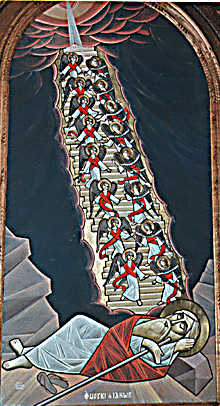 Genesis 28
Jacobs Dream at Bethel
10Meanwhile, Jacob left Beersheba and traveled toward Haran. 11At sundown he arrived at a good place to set up camp and stopped there for the night. Jacob found a stone for a pillow and lay down to sleep. 12As he slept, he dreamed of a stairway that reached from earth to heaven. And he saw the angels of God going up and down on it.
13At the top of the stairway stood the LORD, and he said, "I am the LORD, the God of your grandfather Abraham and the God of your father, Isaac. The ground you are lying on belongs to you. I will give it to you and your descendants. 14Your descendants will be as numerous as the dust of the earth! They will cover the land from east to west and from north to south. All the families of the earth will be blessed through you and your descendants.[a] 15What's more, I will be with you, and I will protect you wherever you go. I will someday bring you safely back to this land. I will be with you constantly until I have finished giving you everything I have promised."
16Then Jacob woke up and said, "Surely the LORD is in this place, and I wasn't even aware of it." 17He was afraid and said, "What an awesome place this is! It is none other than the house of God--the gateway to heaven!" 18The next morning he got up very early. He took the stone he had used as a pillow and set it upright as a memorial pillar. Then he poured olive oil over it. 19He named the place Bethel--"house of God"--though the name of the nearby village was Luz.
20Then Jacob made this vow: "If God will be with me and protect me on this journey and give me food and clothing, 21and if he will bring me back safely to my father, then I will make the LORD my God. 22This memorial pillar will become a place for worshiping God, and I will give God a tenth of everything he gives me."
Footnotes:
Genesis 28:14 Hebrew seed.
Genesis 29
Jacob Arrives at Paddan-Aram
1Jacob hurried on, finally arriving in the land of the east. 2He saw in the distance three flocks of sheep lying in an open field beside a well, waiting to be watered. But a heavy stone covered the mouth of the well. 3It was the custom there to wait for all the flocks to arrive before removing the stone. After watering them, the stone would be rolled back over the mouth of the well. 4Jacob went over to the shepherds and asked them, "Where do you live?"
"At Haran," they said.
5"Do you know a man there named Laban, the grandson of Nahor?"
"Yes, we do," they replied.
6"How is he?" Jacob asked.
"He's well and prosperous. Look, here comes his daughter Rachel with the sheep."
7"Why don't you water the flocks so they can get back to grazing?" Jacob asked. "They'll be hungry if you stop so early in the day."
8"We don't roll away the stone and begin the watering until all the flocks and shepherds are here," they replied.
9As this conversation was going on, Rachel arrived with her father's sheep, for she was a shepherd. 10And because she was his cousin, the daughter of his mother's brother, and because the sheep were his uncle's, Jacob went over to the well and rolled away the stone and watered his uncle's flock. 11Then Jacob kissed Rachel, and tears came to his eyes. 12He explained that he was her cousin on her father's side, her aunt Rebekah's son. So Rachel quickly ran and told her father, Laban.
13As soon as Laban heard about Jacob's arrival, he rushed out to meet him and greeted him warmly. Laban then brought him home, and Jacob told him his story. 14"Just think, my very own flesh and blood!" Laban exclaimed.
Jacob Marries Leah and Rachel
After Jacob had been there about a month, 15Laban said to him, "You shouldn't work for me without pay just because we are relatives. How much do you want?"
16Now Laban had two daughters: Leah, who was the oldest, and her younger sister, Rachel. 17Leah had pretty eyes,[a] but Rachel was beautiful in every way, with a lovely face and shapely figure. 18Since Jacob was in love with Rachel, he told her father, "I'll work for you seven years if you'll give me Rachel, your younger daughter, as my wife."
19"Agreed!" Laban replied. "I'd rather give her to you than to someone outside the family."
20So Jacob spent the next seven years working to pay for Rachel. But his love for her was so strong that it seemed to him but a few days. 21Finally, the time came for him to marry her. "I have fulfilled my contract," Jacob said to Laban. "Now give me my wife so we can be married."
22So Laban invited everyone in the neighborhood to celebrate with Jacob at a wedding feast. 23That night, when it was dark, Laban took Leah to Jacob, and he slept with her. 24And Laban gave Leah a servant, Zilpah, to be her maid.
25But when Jacob woke up in the morning--it was Leah! "What sort of trick is this?" Jacob raged at Laban. "I worked seven years for Rachel. What do you mean by this trickery?"
26"It's not our custom to marry off a younger daughter ahead of the firstborn," Laban replied. 27"Wait until the bridal week is over, and you can have Rachel, too--that is, if you promise to work another seven years for me."
28So Jacob agreed to work seven more years. A week after Jacob had married Leah, Laban gave him Rachel, too. 29And Laban gave Rachel a servant, Bilhah, to be her maid. 30So Jacob slept with Rachel, too, and he loved her more than Leah. He then stayed and worked the additional seven years.
Jacob's Many Children
31But because Leah was unloved, the LORD let her have a child, while Rachel was childless. 32So Leah became pregnant and had a son. She named him Reuben,[b] for she said, "The LORD has noticed my misery, and now my husband will love me." 33She soon became pregnant again and had another son. She named him Simeon,[c] for she said, "The LORD heard that I was unloved and has given me another son." 34Again she became pregnant and had a son. She named him Levi,[d] for she said, "Surely now my husband will feel affection for me, since I have given him three sons!" 35Once again she became pregnant and had a son. She named him Judah,[e] for she said, "Now I will praise the LORD!" And then she stopped having children.
Footnotes:
Genesis 29:17 Or dull eyes. The meaning of the Hebrew is uncertain.
Genesis 29:32 Reuben means "Look, a son!" It also sounds like the Hebrew for "He has seen my misery."
Genesis 29:33 Simeon probably means "one who hears."
Genesis 29:34 Levi sounds like a Hebrew term that means "being attached" or "feeling affection for."
Genesis 29:35 Judah sounds like the Hebrew term for "praise."
Genesis 30
1 When Rachel saw that she wasn't having any children, she became jealous of her sister. "Give me children, or I'll die!" she exclaimed to Jacob.
2Jacob flew into a rage. "Am I God?" he asked. "He is the only one able to give you children!"
3Then Rachel told him, "Sleep with my servant, Bilhah, and she will bear children for me." 4So Rachel gave him Bilhah to be his wife, and Jacob slept with her. 5Bilhah became pregnant and presented him with a son. 6Rachel named him Dan,[a] for she said, "God has vindicated me! He has heard my request and given me a son." 7Then Bilhah became pregnant again and gave Jacob a second son. 8Rachel named him Naphtali,[b] for she said, "I have had an intense struggle with my sister, and I am winning!"
9Meanwhile, Leah realized that she wasn't getting pregnant anymore, so she gave her servant, Zilpah, to Jacob to be his wife. 10Soon Zilpah presented him with another son. 11Leah named him Gad,[c] for she said, "How fortunate I am!" 12Then Zilpah produced a second son, 13and Leah named him Asher,[d] for she said, "What joy is mine! The other women will consider me happy indeed!"
14One day during the wheat harvest, Reuben found some mandrakes growing in a field and brought the roots to his mother, Leah. Rachel begged Leah to give some of them to her. 15But Leah angrily replied, "Wasn't it enough that you stole my husband? Now will you steal my son's mandrake roots, too?"
Rachel said, "I will let him sleep with you tonight in exchange for the mandrake roots."
16So that evening, as Jacob was coming home from the fields, Leah went out to meet him. "You must sleep with me tonight!" she said. "I have paid for you with some mandrake roots my son has found." So Jacob slept with her. 17And God answered her prayers. She became pregnant again and gave birth to her fifth son. 18She named him Issachar,[e] for she said, "God has rewarded me for giving my servant to my husband as a wife." 19Then she became pregnant again and had a sixth son. 20She named him Zebulun,[f] for she said, "God has given me good gifts for my husband. Now he will honor me, for I have given him six sons." 21Later she gave birth to a daughter and named her Dinah.
22Then God remembered Rachel's plight and answered her prayers by giving her a child. 23She became pregnant and gave birth to a son. "God has removed my shame," she said. 24And she named him Joseph,[g] for she said, "May the LORD give me yet another son."
Jacobs Wealth Increases
25Soon after Joseph was born to Rachel, Jacob said to Laban, "I want to go back home. 26Let me take my wives and children, for I have earned them from you, and let me be on my way. You know I have fully paid for them with my service to you."
27"Please don't leave me," Laban replied, "for I have learned by divination that the LORD has blessed me because you are here. 28How much do I owe you? Whatever it is, I'll pay it."
29Jacob replied, "You know how faithfully I've served you through these many years, and how your flocks and herds have grown. 30You had little indeed before I came, and your wealth has increased enormously. The LORD has blessed you from everything I do! But now, what about me? When should I provide for my own family?"
31"What wages do you want?" Laban asked again.
Jacob replied, "Don't give me anything at all. Just do one thing, and I'll go back to work for you. 32Let me go out among your flocks today and remove all the sheep and goats that are speckled or spotted, along with all the dark-colored sheep. Give them to me as my wages. 33This will make it easy for you to see whether or not I have been honest. If you find in my flock any white sheep or goats that are not speckled, you will know that I have stolen them from you."
34"All right," Laban replied. "It will be as you have said." 35But that very day Laban went out and removed all the male goats that were speckled and spotted, the females that were speckled and spotted with any white patches, and all the dark-colored sheep. He placed them in the care of his sons, 36and they took them three days' distance from where Jacob was. Meanwhile, Jacob stayed and cared for Laban's flock.
37Now Jacob took fresh shoots from poplar, almond, and plane trees and peeled off strips of the bark to make white streaks on them. 38Then he set up these peeled branches beside the watering troughs so Laban's flocks would see them as they came to drink, for that was when they mated. 39So when the flocks mated in front of the white-streaked branches, all of their offspring were streaked, speckled, and spotted. 40Jacob added them to his own flock, thus separating the lambs from Laban's flock. Then at mating time, he turned the flocks toward the streaked and dark-colored rams in Laban's flock. This is how he built his flock from Laban's. 41Whenever the stronger females were ready to mate, Jacob set up the peeled branches in front of them. 42But he didn't do this with the weaker ones, so the weaker lambs belonged to Laban, and the stronger ones were Jacob's. 43As a result, Jacob's flocks increased rapidly, and he became very wealthy, with many servants, camels, and donkeys.
Footnotes:
Genesis 30:6 Dan is a play on the Hebrew term meaning "to vindicate" or "to judge."
Genesis 30:8 Naphtali means "my struggle."
Genesis 30:11 Gad means "good fortune."
Genesis 30:13 Asher means "happy."
Genesis 30:18 Issachar sounds like a Hebrew term that means "reward."
Genesis 30:20 Zebulun probably means "honor."
Genesis 30:24 Joseph means "may he add."

Genesis 26
Isaac Deceives Abimelech
1Now a severe famine struck the land, as had happened before in Abraham's time. So Isaac moved to Gerar, where Abimelech, king of the Philistines, lived.
2The LORD appeared to him there and said, "Do not go to Egypt. 3Do as I say, and stay here in this land. If you do, I will be with you and bless you. I will give all this land to you and your descendants, just as I solemnly promised Abraham, your father. 4I will cause your descendants to become as numerous as the stars, and I will give them all these lands. And through your descendants[a] all the nations of the earth will be blessed. 5I will do this because Abraham listened to me and obeyed all my requirements, commands, regulations, and laws."
6So Isaac stayed in Gerar. 7And when the men there asked him about Rebekah, he said, "She is my sister." He was afraid to admit that she was his wife. He thought they would kill him to get her, because she was very beautiful. 8But some time later, Abimelech, king of the Philistines, looked out a window and saw Isaac fondling Rebekah.
9Abimelech called for Isaac and exclaimed, "She is obviously your wife! Why did you say she was your sister?"
"Because I was afraid someone would kill me to get her from me," Isaac replied.
10"How could you treat us this way!" Abimelech exclaimed. "Someone might have taken your wife and slept with her, and you would have made us guilty of great sin." 11Then Abimelech made a public proclamation: "Anyone who harms this man or his wife will die!"
Conflict over Water Rights
12That year Isaac's crops were tremendous! He harvested a hundred times more grain than he planted, for the LORD blessed him. 13He became a rich man, and his wealth only continued to grow. 14He acquired large flocks of sheep and goats, great herds of cattle, and many servants. Soon the Philistines became jealous of him, 15and they filled up all of Isaac's wells with earth. These were the wells that had been dug by the servants of his father, Abraham.
16And Abimelech asked Isaac to leave the country. "Go somewhere else," he said, "for you have become too rich and powerful for us."
17So Isaac moved to the Gerar Valley and lived there instead. 18He reopened the wells his father had dug, which the Philistines had filled in after Abraham's death. Isaac renamed them, using the names Abraham had given them. 19His shepherds also dug in the Gerar Valley and found a gushing spring.
20But then the local shepherds came and claimed the spring. "This is our water," they said, and they argued over it with Isaac's herdsmen. So Isaac named the well "Argument,"[b] because they had argued about it with him. 21Isaac's men then dug another well, but again there was a fight over it. So Isaac named it "Opposition."[c] 22Abandoning that one, he dug another well, and the local people finally left him alone. So Isaac called it "Room Enough,"[d] for he said, "At last the LORD has made room for us, and we will be able to thrive."
23From there Isaac moved to Beersheba, 24where the LORD appeared to him on the night of his arrival. "I am the God of your father, Abraham," he said. "Do not be afraid, for I am with you and will bless you. I will give you many descendants, and they will become a great nation. I will do this because of my promise to Abraham, my servant." 25Then Isaac built an altar there and worshiped the LORD. He set up his camp at that place, and his servants dug a well.
A Treaty with Abimelech
26One day Isaac had visitors from Gerar. King Abimelech arrived with his adviser, Ahuzzath, and also Phicol, his army commander. 27"Why have you come?" Isaac asked them. "This is obviously no friendly visit, since you sent me from your land in a most unfriendly way."
28They replied, "We can plainly see that the LORD is with you. So we decided we should have a treaty, a covenant between us. 29Swear that you will not harm us, just as we did not harm you. We have always treated you well, and we sent you away from us in peace. And now look how the LORD has blessed you!"
30So Isaac prepared a great feast for them, and they ate and drank in preparation for the treaty ceremony. 31Early the next morning, they each took a solemn oath of nonaggression. Then Isaac sent them home again in peace. 32That very day Isaac's servants came and told him about a well they had dug. "We've found water!" they said. 33So Isaac named the well "Oath,"[e] and from that time to this, the town that grew up there has been called Beersheba--"well of the oath."
34At the age of forty, Esau married a young woman named Judith, the daughter of Beeri the Hittite. He also married Basemath, the daughter of Elon the Hittite. 35But Esau's wives made life miserable for Isaac and Rebekah.
Footnotes:
Genesis 26:4 Hebrew seed.
Genesis 26:20 Hebrew Esek.
Genesis 26:21 Hebrew Sitnah.
Genesis 26:22 Hebrew Rehoboth.
Genesis 26:33 Hebrew Shibah, which can mean "oath" or "seven."
Genesis 27
Jacob Steals Esaus Blessing
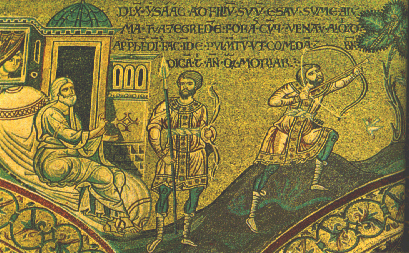
1When Isaac was old and almost blind, he called for Esau, his older son, and said, "My son?"
"Yes, Father?" Esau replied.
2"I am an old man now," Isaac said, "and I expect every day to be my last. 3Take your bow and a quiver full of arrows out into the open country, and hunt some wild game for me. 4Prepare it just the way I like it so it's savory and good, and bring it here for me to eat. Then I will pronounce the blessing that belongs to you, my firstborn son, before I die."
5But Rebekah overheard the conversation. So when Esau left to hunt for the wild game, 6she said to her son Jacob, "I overheard your father asking Esau 7to prepare him a delicious meal of wild game. He wants to bless Esau in the LORD's presence before he dies. 8Now, my son, do exactly as I tell you. 9Go out to the flocks and bring me two fine young goats. I'll prepare your father's favorite dish from them. 10Take the food to your father; then he can eat it and bless you instead of Esau before he dies."
11"But Mother!" Jacob replied. "He won't be fooled that easily. Think how hairy Esau is and how smooth my skin is! 12What if my father touches me? He'll see that I'm trying to trick him, and then he'll curse me instead of blessing me."
13"Let the curse fall on me, dear son," said Rebekah. "Just do what I tell you. Go out and get the goats."
14So Jacob followed his mother's instructions, bringing her the two goats. She took them and cooked a delicious meat dish, just the way Isaac liked it. 15Then she took Esau's best clothes, which were there in the house, and dressed Jacob with them. 16She made him a pair of gloves from the hairy skin of the young goats, and she fastened a strip of the goat's skin around his neck. 17Then she gave him the meat dish, with its rich aroma, and some freshly baked bread. 18Jacob carried the platter of food to his father and said, "My father?"
"Yes, my son," he answered. "Who is it--Esau or Jacob?"
19Jacob replied, "It's Esau, your older son. I've done as you told me. Here is the wild game, cooked the way you like it. Sit up and eat it so you can give me your blessing."
20Isaac asked, "How were you able to find it so quickly, my son?"
"Because the LORD your God put it in my path!" Jacob replied.
21Then Isaac said to Jacob, "Come over here. I want to touch you to make sure you really are Esau." 22So Jacob went over to his father, and Isaac touched him. "The voice is Jacob's, but the hands are Esau's," Isaac said to himself. 23But he did not recognize Jacob because Jacob's hands felt hairy just like Esau's. So Isaac pronounced his blessing on Jacob. 24"Are you really my son Esau?" he asked.
"Yes, of course," Jacob replied.
25Then Isaac said, "Now, my son, bring me the meat. I will eat it, and then I will give you my blessing." So Jacob took the food over to his father, and Isaac ate it. He also drank the wine that Jacob served him. Then Isaac said, 26"Come here and kiss me, my son."
27So Jacob went over and kissed him. And when Isaac caught the smell of his clothes, he was finally convinced, and he blessed his son. He said, "The smell of my son is the good smell of the open fields that the LORD has blessed. 28May God always give you plenty of dew for healthy crops and good harvests of grain and wine. 29May many nations become your servants. May you be the master of your brothers. May all your mother's sons bow low before you. All who curse you are cursed, and all who bless you are blessed."
30As soon as Isaac had blessed Jacob, and almost before Jacob had left his father, Esau returned from his hunting trip. 31Esau prepared his father's favorite meat dish and brought it to him. Then he said, "I'm back, Father, and I have the wild game. Sit up and eat it so you can give me your blessing."
32But Isaac asked him, "Who are you?"
"Why, it's me, of course!" he replied. "It's Esau, your older son."
33Isaac began to tremble uncontrollably and said, "Then who was it that just served me wild game? I have already eaten it, and I blessed him with an irrevocable blessing before you came."
34When Esau understood, he let out a loud and bitter cry. "O my father, bless me, too!" he begged.
35But Isaac said, "Your brother was here, and he tricked me. He has carried away your blessing."
36Esau said bitterly, "No wonder his name is Jacob,[a] for he has deceived me twice, first taking my birthright and now stealing my blessing. Oh, haven't you saved even one blessing for me?"
37Isaac said to Esau, "I have made Jacob your master and have declared that all his brothers will be his servants. I have guaranteed him an abundance of grain and wine--what is there left to give?"
38Esau pleaded, "Not one blessing left for me? O my father, bless me, too!" Then Esau broke down and wept.
39His father, Isaac, said to him, "You will live off the land and what it yields, 40and you will live by your sword. You will serve your brother for a time, but then you will shake loose from him and be free."
Jacob Flees to Paddan-Aram
41Esau hated Jacob because he had stolen his blessing, and he said to himself, "My father will soon be dead and gone. Then I will kill Jacob."
42But someone got wind of what Esau was planning and reported it to Rebekah. She sent for Jacob and told him, "Esau is threatening to kill you. 43This is what you should do. Flee to your uncle Laban in Haran. 44Stay there with him until your brother's fury is spent. 45When he forgets what you have done, I will send for you. Why should I lose both of you in one day?"
46Then Rebekah said to Isaac, "I'm sick and tired of these local Hittite women. I'd rather die than see Jacob marry one of them."
Footnotes:
Genesis 27:36 Jacob means "he grasps the heel"; this can also figuratively mean "he deceives."
Genesis 28:1-9
Genesis 28
1 So Isaac called for Jacob, blessed him, and said, "Do not marry any of these Canaanite women. 2Instead, go at once to Paddan-aram, to the house of your grandfather Bethuel, and marry one of your uncle Laban's daughters. 3May God Almighty bless you and give you many children. And may your descendants become a great assembly of nations! 4May God pass on to you and your descendants the blessings he promised to Abraham. May you own this land where we now are foreigners, for God gave it to Abraham."
5So Isaac sent Jacob away, and he went to Paddan-aram to stay with his uncle Laban, his mother's brother, the son of Bethuel the Aramean.
6Esau heard that his father had blessed Jacob and sent him to Paddan-aram to find a wife, and that he had warned Jacob not to marry a Canaanite woman. 7He also knew that Jacob had obeyed his parents and gone to Paddan-aram. 8It was now very clear to Esau that his father despised the local Canaanite women. 9So he visited his uncle Ishmael's family and married one of Ishmael's daughters, in addition to the wives he already had. His new wife's name was Mahalath. She was the sister of Nebaioth and the daughter of Ishmael, Abraham's son.
Genesis 25
The Death of Abraham
1Now Abraham married again. Keturah was his new wife, 2and she bore him Zimran, Jokshan, Medan, Midian, Ishbak, and Shuah. 3Jokshan's two sons were Sheba and Dedan. Dedan's descendants were the Asshurites, Letushites, and Leummites. 4Midian's sons were Ephah, Epher, Hanoch, Abida, and Eldaah. These were all descendants of Abraham through Keturah.
5Abraham left everything he owned to his son Isaac. 6But before he died, he gave gifts to the sons of his concubines and sent them off to the east, away from Isaac.
7Abraham lived for 175 years, 8and he died at a ripe old age, joining his ancestors in death. 9His sons Isaac and Ishmael buried him in the cave of Machpelah, near Mamre, in the field of Ephron son of Zohar the Hittite. 10This was the field Abraham had purchased from the Hittites, where he had buried his wife Sarah. 11After Abraham's death, God poured out rich blessings on Isaac, who settled near Beer-lahairoi in the Negev.
Ishmaels Descendants
12This is the history of the descendants of Ishmael, the son of Abraham through Hagar, Sarah's Egyptian servant. 13Here is a list, by their names and clans, of Ishmael's descendants: The oldest was Nebaioth, followed by Kedar, Adbeel, Mibsam, 14Mishma, Dumah, Massa, 15Hadad, Tema, Jetur, Naphish, and Kedemah. 16These twelve sons of Ishmael became the founders of twelve tribes that bore their names, listed according to the places they settled and camped. 17Ishmael finally died at the age of 137 and joined his ancestors in death. 18Ishmael's descendants were scattered across the country from Havilah to Shur, which is east of Egypt in the direction of Asshur. The clans descended from Ishmael camped close to one another.[a]
The Births of Jacob and Esau
19This is the history of the family of Isaac, the son of Abraham. 20When Isaac was forty years old, he married Rebekah, the daughter of Bethuel the Aramean from Paddan-aram and the sister of Laban. 21Isaac pleaded with the LORD to give Rebekah a child because she was childless. So the LORD answered Isaac's prayer, and his wife became pregnant with twins. 22But the two children struggled with each other in her womb. So she went to ask the LORD about it. "Why is this happening to me?" she asked.
23And the LORD told her, "The sons in your womb will become two rival nations. One nation will be stronger than the other; the descendants of your older son will serve the descendants of your younger son."
24And when the time came, the twins were born. 25The first was very red at birth. He was covered with so much hair that one would think he was wearing a piece of clothing. So they called him Esau.[b] 26Then the other twin was born with his hand grasping Esau's heel. So they called him Jacob.[c] Isaac was sixty years old when the twins were born.
Esau Sells His Birthright
27As the boys grew up, Esau became a skillful hunter, a man of the open fields, while Jacob was the kind of person who liked to stay at home. 28Isaac loved Esau in particular because of the wild game he brought home, but Rebekah favored Jacob.
29One day when Jacob was cooking some stew, Esau arrived home exhausted and hungry from a hunt. 30Esau said to Jacob, "I'm starved! Give me some of that red stew you've made." (This was how Esau got his other name, Edom--"Red.")
31Jacob replied, "All right, but trade me your birthright for it."
32"Look, I'm dying of starvation!" said Esau. "What good is my birthright to me now?"
33So Jacob insisted, "Well then, swear to me right now that it is mine." So Esau swore an oath, thereby selling all his rights as the firstborn to his younger brother. 34Then Jacob gave Esau some bread and lentil stew. Esau ate and drank and went on about his business, indifferent to the fact that he had given up his birthright.
Footnotes:
Genesis 25:18 The meaning of the Hebrew is uncertain.
Genesis 25:25 Esau sounds like a Hebrew term that means "hair."
Genesis 25:26 Jacob means "he grasps the heel"; this can also figuratively mean "he deceives."

Hagar, victim or villain? Three sixteenth-century views
John L Thompson
ALTHOUGH BARELY TWO DECADES ave passed since the world of biblical scholarship began to recognize the existence of women in the Old Testament,1 today such studies appear in an eve -increasing torrent. One particularly significant catalyst was undoubtedly t he book by Phyllis Trible published in 1984 and entitled Texts of Terror, an evocative study focused on the numbingly tragic stories of four women of the Ol Testament, one of whom was Hagar.2 To be sure, Hagar's tragic tale of servitude and surrogacy, flight and exile, had been regularly commemorated since the early nineteenth century for its striking parallel to the African-Amer can experience of slavery and abuse,3 so the more recent awakening in acad mic circles must not credited with too much originality. Nonetheless, feminist and womanist critics, by drawing inspiration from one another, have both multiplied and diversified their respective findings, so that in the past ten years Hagar's story has been read with far greater sympathy and from a variety of perspectives.4
Together, feminist and womanist critics have endeavored to reconstruct and restore our memory of Hagar, as well as to pose the uncomfortable question why we have so blithely passed over Hagar's contribution to the biblical story and the wrongs done to her. These recent investigations have called attention to a number of remarkable features that ought to signal Hagar as one of the preeminent biblical heroes. To begin with, she is the first person in the Bible to be visited by an angel (Gen 16:7), as well as the first to receive an annunciation (16:11-12). Sarah, by contrast, is spoken to by God only in rebuke (18:15). Hagar is also the only woman in all of Scripture ever to receive a promise of innumerable descendants (16:10). And perhaps most striking of all, Hagar is depicted in Gen 16:13 as boldly bestowing a name on God-"a power attributed to no one else in all the Bible."5
Unfortunately, Hagar is also among the first biblical women to experience "use, abuse, and rejection."6 Not only is Hagar marginalized by her status as a slave, she is further coerced into serving as a surrogate for the barren Sarah. But Hagar's success only alienates her mistress: she flees from Sarah's harsh treatment into the desert, where an angel of the Lord intervenes and commands Hagar: "Return to your mistress and submit to her" (16:9). A similar scenario develops after the birth of Isaac, many years later.7 Sarah, apparently fearing that Hagar and Ishmael will contrive to rob Isaac of his primogeniture, orders them banished. Spurred on by a word of divine intervention, a displeased Abraham complies (21:9-14). Hagar and Ishmael depart, woefully underprovisioned, and they escape death in the desert only when God intervenes. Hagar thus has the misfortune to be the vector of all sorts of malfeasance, neglect, and even inhumanity: Sarah envies her and despises her son, while Abraham stands waffling in the wings, eventually condemning his concubine to exile and, quite possibly, death.
But there is a more disturbing observation to be registered. It is bad enough that Hagar bears the brunt of Sarah's wrath and Abraham's cowardly indifference, but Hagar seems to have another enemy in these stories: God. It is God who rescues her, yes, but it is also God who orders her to return and submit to Sarah's enmity and mistreatment; and it is God who sanctions the plan to send Hagar and Ishmael into the wilderness. The hostility of God towards an arguably innocent slave woman is what undergirds the terror and tragedy which have disturbed many readers today.8
Most of these recent critics would agree that stories such as that of Hagar both display and indict the patriarchal biases of the Bible and its interpreters.9 Indeed, feminist and womanist commentators surely bring to their craft an awareness of the role played by presuppositions and self-interest which is not to be found among earlier interpreters. But have the commentators of bygone days always been as neglectful-not to say heartless-towards Hagar as modern critics seem to presume? Has the exegetical tradition only so recently remembered Hagar? It is precisely here that the present study finds its point of departure. What, in fact, have earlier commentators thought about Hagar? Did they ignore her? Did they vilify her? We will seek answers to these questions from representatives of the three main sources for commentaries on the Bible in the sixteenth century: Catholic, Reformed, and Lutheran.10
I. Thomas de Vio, Cardinal Cajetan
One of the earliest commentaries on Genesis in the Reformation era was the work of one of Martin Luther's opponents-Thomas de Vio, Cardinal Cajetan. In the last decade of his life he commented on the Psalms (1527), then on every book of the New Testament except the Apocalypse. In 1529 he turned his attention to the Old Testament. His death in 1534 found him in the early chapters of Isaiah. Cajetan's is a peculiar commentary for his day: he rarely cites any of the Fathers or medievals, he seems to ignore everything but the literal sense, and he is obsessed with capturing the nuance of the original language in his own translation, even if a literal rendition leaves the meaning obscure. For all of these features, Cajetan was often excoriated, and even censured, by his most immediate Roman Catholic contemporaries, though Luther is reported to have praised Cajetan's exegesis, and his work may have received a warm reception also in Geneva.11
Cajetan's treatment of Hagar is evenhanded, if somewhat spare, as may be illustrated by his comments on Genesis 16. Cajetan, in his own way, affirms the traditional portrait of Hagar as a runaway slave brought to sincere repentance. To be sure, Hagar is a slave, and in the history of salvation the good things which happen to her and her son are performed by God particularly for the sake of Sarah and Abraham.12 Indeed, Cajetan seems to underscore the contrast whereby "the first cause of being" condescends to exercise special care "even for a mere woman."13 But these points do not lead Cajetan to impugn the character of either Hagar or Ishmael-far from it! Hagar's repentance is staged against the backdrop of an epiphany which Cajetan likens to the setting of the Magnificat, insofar as both Hagar and the Blessed Virgin, "having been greeted by the angel, pondered the nature of that greeting.14 Hagar's joyful and repentant response, moreover, is utterly unfeigned, as Cajetan's perfectly Thomistic explanation makes clear:
Hagar, having heeded the angel joyfully, and now properly prepared for her pregnancy, contemplated who indeed was promising such things to her, surmising, at last, a divine messenger. And while the angel was silent, God was continuously at work within her, disposing Hagar's mind and will at every point while she was contemplating, so that she might merit the angel's third speech.15
Even if part of Hagar's affliction was justly inflicted by Sarah, Cajetan observes, she cried out for divine mercy. God heard her cry, for her afflictions deserved his attention. Consequently, Hagar's act of naming God (in Gen 16:13) acknowledges the benefits she received and constitutes an act of thanksgiving, as does her subsequent naming of the well in honor of "the living God who saw me."l6
At this point it is worth noting also how Cajetan deals with Hagar's son. An intriguing observation emerges at Gen 16:11, where he comments on the unusual naming of Ishmael. His remarks are deceptive, insofar as they cloak his consideration of earlier writers:
Do not fail to notice that to no one prior to Ishmael did God give a name. Indeed, he is the first among humans to receive a name from God. But from this novel and not insignificant blessing (gratia), nothing is known as to whether Ishmael was good or evil; no one should boast of having received God's freely given blessing, nor should anyone be praised, nor should anyone presume that such a person is good.17
One may properly ask why Cajetan adds this comment about Ishmael's moral character. In fact, Cajetan here demonstrates that he is not at all ignorant of earlier exegesis but is consciously rejecting it, for at the very same locus two of Cajetan's medieval predecessors-Nicolas of Lyra and Denis the Carthusian-not only note the novelty of Ishmael's naming but also report much deliberation over the question how Ishmael could have merited such a blessing in view of his supposedly evil character, in which not the least element was his "persecution" of Isaac (a la Galatians 4).18 Clearly, Cajetan is alluding to this debate, but he has declined to report the traditional, pejorative account of Ishmael in Christian sources, and especially in rabbinic sources.
Cajetan also defends Ishmael at two other points where his reputation traditionally suffered: Gen 21:9 and Gen 21:20. From the former text, Nicolas of Lyra (with help from the rabbis) had drawn many startling connotations which might underlie Ishmael's "play" with his half brother, including the sins of idolatry, murder, and licentiousness. But for Cajetan, Ishmael's "play" indicated simply that he had mocked Isaac and encouraged other boys to do likewise. To be sure, this is what Paul would later term "persecution," but Cajetan (speaking for Abraham) finds in Ishmael no fault deserving of so harsh a punishment as exile.19 At Gen 21:20, Cajetan, defending Ishmael, again alludes to earlier exegesis. The biblical text simply states that "God was with the lad." Cajetan takes this statement as sufficient refutation of the "nonsensical" view (nugas) that Ishmael grew up to become a brigand or highwayman-a slanderous view found, once more, in rabbinic commentaries and reported by Christian writers as well.20
Cajetan's defense of Ishmael is pertinent precisely for the way it confirms his intention to extend more charity to Hagar, too, than was then the norm. Thus, against those who think that Hagar literally "threw" her son under a tree (in Gen 21:15), Cajetan finds it "nefarious to think that so pious a mother would add affliction to her already afflicted, only-begotten son."21 Against those earlier exegetes (Rashi, though he is not named) who excoriated Hagar for returning to Egypt and idolatry and for procuring an Egyptian wife, Cajetan simply explains as a matter of course that "we are all naturally inclined to prefer our own people."22 Admittedly, Cajetan's "defensive" moves here are probably impelled largely by his commitment to the literal sense, but it is equally true that he sees the "literal" blessing of God in the lives of Ishmael and Hagar, and that he will allow neither speculation nor an ostensibly Pauline allegory or polemic to obscure these other aspects of the "literal" story line.
There is one final exegetical point in Cajetan which further favors Hagar and Ishmael. In Cajetan's comments on Genesis 21, he seems scarcely troubled by many traditional problems, such as the impropriety of Abraham's being bossed about by his wife, or how Sarah could have known God's will better than Abraham himself did. What seriously worries Cajetan, however, is whether Abraham inhumanely underprovisioned Hagar and Ishmael before sending them off. To be sure, Gen 21:14 is ambiguous: when Abraham put bread and water on Hagar's shoulders, "along with the child," does the text mean he put Ishmael-a boy usually reckoned, Cajetan observes, at about seventeen years of age!-on her shoulders too? Or did he put the supplies also on the young man? Either way, one still might stumble over the next question,
How it was fitting that Abraham, who was so wealthy, provided for his wife and son so sparingly (exigue)-or rather, so miserably (misere)!-that he should give his wife only as much bread and water as she could carry on her shoulders. The solution is that by "bread and water" is to be understood all kinds of provision (omnia victualia), and that Abraham provided copiously and quite prudently so that he would even have provided a jar to keep the water fresh (prouiderit de vase seruatiuo aquae) along the way. This indeed was fitting for a well-to-do father unwillingly having to send his son away. Also, he gave neither the provisions nor his son to Hagar to be carried; rather, to carry the supplies and his son and Hagar herself, he provided asses or other pack animals, as well as attendants. . . . Truly, it is impious (nefas est) to believe that he would have sent his wife and his young son out on foot and without provisions.23
Cajetan defends his elaborate reconstruction, insisting that all these details are not made up but are demanded by the literal reading.24 Nonetheless, the entire matter really boils down to a single premise and conclusion: to exile someone without proper supplies amounts to cruelty, if not murder; and since Abraham was a decent man, such brutality on his part is inconceivable. Even if Cajetan's primary concern here was to exonerate Abraham, for us it is Cajetan's humanity which emerges more clearly than Abraham's. Cajetan, too, is a decent man, and he cannot conceive that Hagar and her son should be treated so heartlessly. And so he takes recourse to the exegete's ultimate act of compassion: he emends the text.
II. John Calvin
Calvin, too, had much to say on these texts, but most of it is rather austere and rigorous. He is far less inclined to allow the momentum of the exegetical tradition, whereby Hagar's behavior was often given the benefit of the doubt,25 to continue unchecked. Instead, the signs of Hagar's piety or repentance traditionally found in the text are all treated by Calvin with great suspicion.
It is important to note that, for Calvin, none of the actors in this drama come away untarnished. Sarah is blamed for having instigated Abraham's polygamy,26 and her "womanly jealousy" and intemperance twice make matters at home even worse.27 Abraham displays more equanimity, but even he is upbraided by Calvin for the fickleness of his affection for Hagar.28 Calvin's treatment of Ishmael, however, is especially instructive. Early on in the saga, when God bestows a name on Ishmael, Calvin tips his hand: Ishmael's name and blessing are at most a mark of God's temporal benefits, granted as a mark of "paternal benevolence" towards the house of Abraham,29 and although Calvin makes little or nothing of the fact that Ishmael's name was divinely imposed, he is concerned to state at the outset that Ishmael was a reprobate (reprobum).30 Calvin's judgment thus conditions how he reads the later statement (Gen 21:20) that "God was with the lad." While Cajetan took this verse as a sign of God's blessing, Calvin distinguishes several modes of God's presence:
He is present with his elect, whom he governs by the special grace of his Spirit; he is also sometimes present as respects external life, not only with his elect but also with strangers (extraneis), in granting them some exceptional benediction.31
Clearly, Ishmael was not elect, but an outsider.
The enigmatic episode in which Ishmael "plays" with his younger brother offers a final illustration of Calvin's dismal expectations. The exegetical restraint for which Calvin is justly admired leads him to pass over in silence the more far-fetched interpretations of "play" found in Nicolas of Lyra and the rabbis. Thus, there is no suggestion of idolatry or lasciviousness, and Calvin explicitly denies that Ishmael assaulted his brother physically. Ishmael's offense was purely verbal, consisting merely of malignant derision, contempt, impious mockery, canine and profane laughter, and petulance.32 But this is no trivial or "playful" matter, Calvin warns,33 because what Ishmael insulted in the person of his brother was God himself, God's grace and God's word, as well as the faith of his father.34 Again, Calvin's implication is clear: Ishmael was a blasphemer.
Like son, like mother? Yes: Hagar receives scant praise from Calvin. She is not merely ungrateful but also positively unbridled, not merely "servile" but also of "indomitable ferocity."35 Having imputed these traits, Calvin appraises Hagar's flight not as the momentary lapse of one of God's saints but as the protracted and not entirely successful mollification of a thoroughly defiant woman.36 At the conclusion of her first flight, Calvin narrates that "Hagar, who had always been wild and rebellious, and who had, at length, entirely shaken off the yoke," was finally broken by affliction.37 But even here one must pause, for Calvin was quite willing to entertain that these signs of Hagar's repentance were insincere!
Moses . . . implies that Hagar, after she was admonished by the angel, changed her mind and, being thus subdued, betook herself to prayer; unless, perhaps, it is the confession of the tongue rather than a change of mind which is here denoted. I rather incline, however, to the opinion that Hagar, who had before been of a wild and intractable temper, begins now at last to acknowledge the providence of God.38
Given Calvin's general reluctance to speculate, his skepticism towards Hagar must run deep if he so freely offers this conjecture. In all probability, too, he knows very well how the story will end, namely, with Hagar's backsliding, with her fatal relapse into unbelief.39
If Hagar displays scarcely any true repentance, it is equally the case that Calvin finds little true piety. Her flight from Sarah in Genesis 16 is culpable for many reasons, Calvin states, but not least because it represents a flight from the true church of that day into apostasy.40 Similarly, when Gen 16:11 reports that "the Lord heard [Hagar's] affliction," many commentators assume she had been crying out to God. Calvin points out, however, that "we do not read that Hagar, in her difficulties, had recourse to prayer." More likely, she was stupefied by her despair, and it was sheerly by the unmerited grace of God that she was delivered despite her "sloth and stupor."41 Things are no better the second time around, either. When the water runs out in Gen 21:15, Hagar is once again paralyzed by her grief.42 Indeed, pondering why "God heard the voice of the lad," when it was Hagar who cried out, Calvin gives little credence to the view that Hagar was thereby deemed unworthy of having her prayers answered. Neither mother nor child was worthy, Calvin avers, and it is but "an uncertain conjecture" that either was brought to repentance by this experience. To the contrary, Calvin opines that neither of them prayed in faith or resorted to divine help at all.43
As a final consideration, one may put the person of Hagar out of mind and inquire simply about the justice of the banishment. Calvin is aware, to be sure, that Sarah's plan was harsh. For Abraham, sending his son away was not different from having his bowels torn out.44 And Calvin is not insensitive to the charge of inhumanity.
But with how slender a provision (tenui . . . viatico) does he endow his wife and son? He places a flagon of water and bread upon her shoulder. Why does he not load an ass, at least, with a moderate supply of food? Why does he not add one of his servants, of which his house contained plenty, as a companion?45
Abraham's answer might have been that he did not want Hagar and Ishmael to get too far away, but God's answer, Calvin tells us, is that this extreme punishment is simply the reward of pride and ingratitude. "God willed that the banishment of Ishmael should be so harsh and sorrowful (tam dura et tristis)," he says, "so that his example might strike terror into the proud, who . .. trample under foot the very grace to which they are indebted for all things. Therefore, he led them both to a miserable end."46 Calvin does not blanch before the harshness and severity of this punishment, for Hagar and Ishmael deserved what they got. Nevertheless, while one might fairly label Calvin's exegesis here as also harsh and severe, one cannot so easily characterize it as traditional.47
III. Martin Luther
Calvin, of course, was not the only Protestant to comment on Genesis. Indeed, he himself surely knew and used the massive commentary composed by Martin Luther from 1535 until shortly before his death in 1546.48 If Calvin found fault with everyone in this narrative, Luther seems to find faith and faithfulness, along with nobility tempered by suffering, wherever he turns. There are surprises for Luther's readers, too. We will begin with a brief look at Luther's comments on Genesis 16, then turn to his even more remarkable suggestions about the meaning of Genesis 21.
Many of Luther's comments on Hagar's conception and on her subsequent contempt for Sarah are not at all new. He echoes the traditional observations about the weakness of women (both Sarah and Hagar), Hagar's servile nature, and Hagar's haughtiness and pride.49 Somewhat more originally, Luther opines that Hagar's flight represented her attempt to force Abraham to declare his affection for her and his expected firstborn-a sort of countercoup to revenge herself against Sarah.50 But the plot of Hagar's story was ultimately directed by God, who brought Hagar to repentance. What Hagar had to learn was that her "affliction" (that is, her subordination to Sarah) was not a sign of God's wrath or neglect, however much it felt like that, but rather something pleasing to God. Once Hagar learned to trust God, everything changed; indeed, she became an example for us. As Luther writes, "most of us are like Hagar," not only in displaying pride towards our perceived inferiors but also insofar as we, too, have been led to faith and repentance. The confession of faith whereby Hagar "names" God is, therefore, also "the hymn of the whole church," "a hymn for the instruction of every one of us," and an act of "true worship" on the part of "saintly Hagar."51
Having registered Luther's encomium for Hagar, we may make two further observations on Genesis 16.
First, there is an intriguing relationship between the remarks of Luther and Calvin here. Summarizing the effect of Hagar's angelic visitation, Luther wrote this sentence: "After this revelation, Hagar, who had been rebellious and impatient of the yoke, has become an entirely different person."52 Luther's affirmation of Hagar's repentance here is neither unprecedented nor particularly surprising. What makes this sentence of special interest is partly that it is a rare instance in which one may detect Calvin's verbal dependence on Luther.53 Yet what is surprising is not Luther's traditional position, or even Calvin's tacit use of Luther (we know he used Luther elsewhere in his Commentary on Genesis), but rather the utter contrast between Luther's sympathetic portrait of Hagar and Calvin's far more begrudging account. Calvin clearly likes the cadence and imagery of Luther's text, but, unlike Luther, he really does not like Hagar. Luther sees Hagar's transformation as real and compelling, so his statement here could fittingly be taken as a hallmark of his overall portrait of Hagar. For Calvin, it is at best the highwater mark of his otherwise wary approach to a suspected hypocrite. Indeed, as we will have even more reason to believe in a moment, Calvin's austere approach to Hagar and Ishmael may well constitute his reaction against what he may have perceived as Luther's lapse from literal exegesis into wishful thinking.
A second observation also underscores Luther's fundamental sympathy for Hagar. Luther could not have foreseen how Calvin would use his words, but he assuredly saw how St. Paul might be used to denigrate Hagar after the fact. Luther's response was unyielding:
I certainly conclude that Hagar should be counted among the saintly women. The fact that Paul compares her to Sarah and calls her a maid who has no place in the home is in no wise a hindrance, for in Scripture even the saints frequently symbolize the ungodly.... Thus Hagar, justified and sanctified by the Word of God, symbolizes the ungodly without detriment to herself.54
Luther hereby initiates a rescue effort on behalf of Hagar and Ishmael for which few precedents can be found, and it is all the more marvelous that he rescues them from no less a canonical threat than the Apostle himself.ss Never mind what Paul says, argues Luther: in her own person, Hagar belongs to God.
Luther's account of Hagar's exile in Genesis 21 also begins with some familiar moves: Hagar sinned through pride; Hagar incited Ishmael to covet the primogeniture; Ishmael's mockery was no trivial matter; Abraham bore a misplaced loyalty to Ishmael; Ishmael deserved to be driven out. These are all traditional observations, though for Luther they are merely prolegomena to the point he began to make in chap. 16, namely, that what seems like tragedy and divine abandonment is in fact God's way of teaching people to trust in God alone. This is Luther's well-known doctrine of the Deus absconditus-the God whose presence is far nearer than we expect, albeit revealed only under a humble guise. Accordingly, one may expect Hagar and Ishmael to learn valuable lessons about faith and trust and humility through their exile, and so they do.
What one does not expect, however-at least, not in light of exegetical tradition-is that Luther's sympathy for Hagar could possibly run as deep as it does. His comments take this unexpected turn when he comes to describe the actual eviction of Hagar at Gen 21:14. There Luther introduces a degree of pathos and poignancy which is simply astonishing, and he rings the changes on this theme for nearly twenty pages of the Weimar edition.
This is surely a sad story if you consider it carefully, although Moses relates it very briefly. After Abraham is sure about God's will, he hastens to obey.... He simply sends away his very dear wife, who was the first to make him a father, along with his firstborn son, and gives them nothing but ein sack mit brott, und ein krug mit wasser.... But does it not seem to be cruelty for a mother who is burdened with a child to be sent away so wretchedly, and to an unfamiliar place at that-yes, into a vast and arid desert?56
Luther does not shirk from describing just how barbarous Abraham appears here: "If someone wanted to rant against Abraham at this point, he could make him the murderer of his son and wife.... Who would believe this if Moses had not recorded it?"57 But Abraham is actually no less anguished than Hagar here; within a few pages Luther has everyone in the narrative weeping, and the readers of the text as well.
It is surely a piteous description, which I can hardly read with dry eyes, that the mother and her son bear their expulsion with such patience and go away into exile. Therefore, Father Abraham either stood there with tears in his eyes and followed them with his blessings and prayers as they went away, or he hid himself somewhere in a nook, where he wept in solitude over his own misfortune and that of the exiles.58
"Trial follows upon trial, and tears force out other tears." Nonetheless, Abraham and Sarah are acting not according to their natural feelings but in obedience to the divine command in vv 12-13. And so Abraham and Sarah urged Hagar and Ishmael "to bear this expulsion patiently; for, as they said, it was God's will expressed by a definite word that Ishmael should leave home and . . . wait for God's blessing in another place."59
All this sadness, then, is not without purpose. Hagar and Ishmael were guilty not only of pride but also of presumption-the presumption that Ishmael's being born first automatically gave him sole rights to what God promised Abraham. The purpose of Ishmael's exile, Luther writes, "is to let him know that the kingdom of God is not owed to him by reason of a natural right but comes out of pure grace.... Ishmael and his mother must learn this lesson, since both wanted to proceed against Isaac on the strength of a right."60 Fortunately, Luther thinks, Hagar and Ishmael did learn this lesson, and, having done so, they were changed and rewarded. Indeed, as Luther's commentary proceeds, it seems as though he could not find enough loose ends to tie up by way of recompense to Hagar, her husband, and her son. With respect to her son, Luther argues that "the expulsion does not mean that Ishmael should be utterly excluded from the kingdom of God."61 Indeed, so well did the contrite Ishmael learn to forsake self-reliance that Luther calls him "a true son of the promise."62 More astonishing still, he
undoubtedly developed into a well-informed and learned preacher who, after he had been taught by his own example, preached that God is the God of those who have been humbled.... After Ishmael had become a husband, he [brought] ... his wife and her relatives and parents to the knowledge of God. Among the uncircumcised heathen he established a church like Abraham's church.... God caused him to become great. . . in the word and spiritual gifts; for, says Moses, God was with him.63
Finally, that Ishmael settled nearby, in Paran (21:21), further indicates to Luther "that Ishmael was reconciled with his father Abraham and his church, although his descendants, as usually happens, gradually deteriorated."
Once again, like mother, like son. Here is how Luther describes the transformation of Hagar in Genesis 21:
Because the Word of God is never proclaimed in vain, Hagar, too, is first awakened from death, as it were, by the angel's voice. Then she is enlightened with . . . the Holy Spirit, and from a slave woman she also becomes a mother of the church, who later on instructed her descendants and warned them by her own example not to act proudly.65
But Luther is still not finished. He thinks that after Hagar's chastisement she returned to live not merely near Abraham but with him, "for the opinion of the Jews that Keturah is Hagar pleases me."66 Embracing this bit of rabbinic speculation here means not only that Luther thinks Hagar bore Abraham another six sons (cf. Gen 25:1-2) but also that he wants so much to read a happy ending that he is willing to credit precisely those exegetes on whom he had previously lavished so much contempt.67
All the same, no degree of happiness ceded to Hagar by way of denouement can possibly arrest the attention of the modern reader nearly as much as Luther's account of one other dimension of the trial endured (albeit in somewhat different ways) by both Abraham and Hagar. If it is true that the ending of this story is happier than one would expect, it is equally true for Luther that the trials which preceded the ending were harsher, and the stakes far higher. Luther's depiction of the exile steps beyond the accounts of his predecessors and anticipates a particularly modern anxiety. That Hagar should have to forsake her pride and presumption is understandable, but that she should be driven away from Abraham also suggests for Luther a terror, a trial, and a temptation far more horrible. To leave Abraham was, for Hagar, to leave the church of her day, indeed, to leave the kingdom of God. What else could this mean but that God was abandoning her unto reprobation? In short, why should Hagar not believe that God hated her?68
Having raised this problem, Luther faces it head-on. Truly, it was God's intention to kill Hagar, spiritually, that he might raise her up.69 But here Luther sees Satan at work, too; Satan typically stirs up lies and "very sad thoughts" in the afflicted, and Hagar wandered aimlessly in the desert, having fallen into a deep stupor.70 Consequently, to comfort and correct Hagar a divine remedy was required, namely, an angelic visitation. "And here," writes Luther,
we are also warned about the purpose: it is not because God hates Ishmael and Hagar that he allows them to be cast out so pitifully. That phony explanation is the fabrication of the devil! God's plan is that they should be humbled and should learn to trust in God's grace alone, not in merits or some carnal prestige.71
God did not hate Hagar, Luther proclaims, but all those who have had their faith tested will understand perfectly why she might have thought he did.72
Luther treats Hagar at length, but he is far less concerned with producing technical or literal exegesis than he is with psychologizing the story.73 Luther even seems a bit self-conscious about his prolixity, for when he mentions how sad or tragic or horrible this story is, as he often does, he feels compelled to concede that "the words are few."74 Finally Luther exclaims, perhaps defensively, "I am not inventing these things, but the very situation and Moses' earlier narrative clearly suggest these circumstances."75 The reader cannot avoid the suspicion that Luther's exegesis here is led more by a warm and tender heart than by a calm and cool detachment. Luther's willingness to psychologize and speculate in this story may also be one reason why Calvin's patience wore thin, not only with Luther but with Hagar as well.
IV. Conclusion
Hagar's treatment by these commentators illumines the history of exegesis in an intriguing way, particularly the history of allegorical exegesis, of its meteoric rise and gradual decline. Of all the stories in Scripture, Hagar's alone receives an allegorical interpretation which is canonically approvedlicensed, so to speak, by St. Paul. Christian interpreters after Paul knew only one text of Genesis, and that was the one already glossed and interpreted in a way that did not flatter Hagar or her son. Consequently, to attend at all to the historical dimension of the story in Genesis would require resisting two impulses, both Pauline: first, to read that story solely in terms of its typological significance, and second, to see Hagar and Ishmael solely as villains.
Much of the earliest commentary on Hagar is, in fact, allegorical and pejorative. To be sure, the medieval history of this text discloses how Christian interpreters added to Paul's allegory in ways which favored Hagar and upstaged Galatians, but that remains a story for another time. In any case, the decline of allegory in the sixteenth century produced no automatic consensus; this fact is illustrated by the diverse conclusions reached by Cajetan, Calvin, and Luther, who, despite their many theological differences, were equally proponents of literal exegesis. It was Luther in particular who gave voice to this tension between letter and allegory, between Genesis and Galatians, between Moses and St. Paul. It was also Luther who resolved it, by deliberately setting the Pauline allegory aside simply as a truth of a different category. In other words, what Paul said Hagar symbolizes or prefigures has no bearing on what she really is or was. In theory, at least, the letter of any text of Scripture always had a certain priority over its figurative meanings, but Luther gave the historical Hagar additional and needed relief from reduction to a mere palimpsest inscribed with the words of St. Paul.
Of course, as Calvin illustrates especially well, not all agreed in their assessments of Hagar; nor, for that matter, did they agree in their estimation of Abraham or Sarah. But Calvin's vigorous dissent is a complicated matter. What were his motives for such hostility towards Hagar and her son? One might venture that his commitment to St. Paul simply overcame all else. If so, then Calvin's position was truly reactionary, insofar as he knew the traditional, ameliorating views of Hagar but chose to ignore them. Indeed, Calvin seems to go beyond Paul: Ishmael's crime was less his ridicule of Isaac than his contempt for the Word of God.'6 Is there a measure of misogynism in Calvin here? Again, the question is complicated. As noted earlier, Calvin was harder on all the figures of the Old Testament, male or female, than his contemporaries were, and he offered no particular distinction between Ishmael's flaws and those of his mother. Moreover, in other contexts Calvin may be seen as marginally more progressive than many of his contemporaries with respect to women.77
In my judgment, anyone attempting to uncover Calvin's agenda for Hagar would do better to attend to the subtle ways in which he reproved the fanciful speculations of his predecessors by invoking the simplicity and austerity of the letter. Admittedly, Calvin was aware not only of conjectures such as Cajetan's and Luther's, which (he thought) exaggerated Hagar's repentance, but also of rabbinic speculations which exaggerated her criminality.'8 However, it seems likely that Calvin was far more threatened, or perhaps simply embarrassed, by the excesses of those such as Luther whom he considered his colleagues in a Reformation ostensibly founded not on midrash but on sola scriptura.
It will be obvious to today's readers that none of these premodern commentators undertakes a systematic critique of androcentrism or of patriarchal exegesis, or shows much awareness of the constraints imposed by social location, or has a mechanism fostering self-criticism at the level of textual commentary. But it is not to be overlooked that these commentators do indwell an ideology (for want of a better term) imbued with a commitment to human dignity, irrespective of gender. To be sure, their commentaries are full of patronizing comments like the commonplace slurs against Hagar's "servile" and "womanish" behavior, but with Cajetan, Luther, and many others, these slurs inevitably gave way to expression of more fundamental human values which might be voiced as astonishment at Abraham's apparent stinginess or as compassion for a mother's tears. Clearly, no matter how strongly the stereotypes of gender, class, race, and religion-as well as the allegorical stereotypes-tended to reduce Hagar to a cipher or a scapegoat, few interpreters were so thoroughly "made of stone" that they were unmoved by her personal sufferings. Luther may be in a class by himself here, but "saintly Hagar" was a model of piety, faith, and endurance for many others as well.
One need not be an avowed feminist to care about Hagar and how she was treated. (One also needs no historical expertise to do so!) What is essential, however, is that one have the ability to empathize and to see oneself in her. As Luther said, "Most of us are like Hagar." Patriarchy may well be oppressive and tiresome, but it is not necessarily a bar to compassion or humanity.79
At the same time, one must observe that no matter how well commentators such as Cajetan and Luther could see themselves in Hagar, and no matter how willing they were to criticize the behavior of Abraham, they did not see themselves in a position to find fault with God. True, they did recognize Abraham's apparent cruelty and Hagar's consequent suffering as deeply serious matters, and they did not minimize the implications for the divine character, but they had no eyes for seeing Scripture as the product or advocate of a covert ideology. They approached Scripture not with suspicion but with charity; far from doubting providence, they gave providence the benefit of any doubt. This is one rift between premodern commentators and today's critics which is not easily bridged, and in the story of Hagar many today find God characterized as the tyrant who sanctioned Hagar's mistreatment and who is as abusive, therefore, as Abraham seemed.
In all fairness, these earlier exegetes must be given credit for at least perceiving the problem, albeit on their own terms. Luther argued that real faith is routinely tested by trials which seem to be exactly like divinely sanctioned abuse. A similar point was made by many others, both Christians and Jews, who saw their own trials of faith in Hagar. But for these commentators, however scandalous God's acts might seem, God remained God. Far better that Hagar should suffer-and, given similar circumstances, far better that we should suffer as faithfully as she did-than that she should join in rebellion against the Deus absconditus. In our own day, of course, we have learned how such words can be preached so as to anesthetize the oppressed, but Luther and his colleagues were almost certainly preaching to themselves, for they asked of Hagar no obedience or submission, however painful, that they themselves did not also pledge.
It is beyond question that feminist and womanist biblical criticism has done well to draw attention to the overlooked characters in the biblical narrative. As a result, modern readers have discovered new dimensions of these stories and have been forced to grapple with the meaning of the text -and with the sadness of the text-in a new way. Moreover, we have been reminded, in the words of Renita Weems, that "women. . . are not an afterthought to salvation."80 Granted that commentators such as Cajetan, Calvin, and Luther often committed the sin of treating women as an afterthought, these writers also show some encouraging inconsistencies which ought to be welcomed as both helpful and challenging. When Luther proclaims Hagar to be a "mother of the church," he offers but one example among many of the way in which premodern and allegedly precritical interpreters may provide significant precedents for a more compassionate and less androcentric reading of stories such as Hagar's.81
1 The date, of course, is both arguable a d arbitrary, but I am taking Phyllis Bird's essay ("Images of Women in the Old Testament," Religion and Sexism: Images of Woman in the Jewish and Christian Traditions [ed. Rosemary Radford Ruether; New York: Simon & Schuster, 1974] 41-88) as a milestone of sorts.
2 Phyllis Trible, Texts of Terror: Literary -Feminist Readings of Biblical Narratives (OBT 18; Philadelphia: Fortress, 1984); see also ead m, God and the Rhetoric of Sexuality (OBT 2; Philadelphia: Fortress, 1978). In a recent cove story, Cullen Murphy ("Women and the Bible," The Atlantic Monthly, August 1993, 48) under ored Trible's influence, observing that these two books "would appear in anyone's canon of fe inist biblical studies." 3 Delores S. Williams (Sisters in the Wilderness: The Challenge of Womanist God-Talk [Maryknoll: Orbis, 1993] 245 n. 2) lists a dozen examples of Hagar's use as a positive exemplar in African-American art and literature. Hagar 's role in other modern literature is summarized
by David Lyle Jeffrey in A Dictionary of Biblical Tradition in English Literature (Grand Rapids: Eerdmans, 1992), s.v. "Hagar."
4 The significance of Hagar for feminist and womanist criticism is widely discussed. See, for example, Alice Ogden Bellis, Helpmates, Harlots, and Heroes: Women's Stories in the Hebrew Bible (Louisville: Westminster/John Knox,1994) 74-79; Katheryn Pfisterer Darr, Far More Precious than Jewels: Perspectives on Biblical Women (Gender and the Biblical Tradition; Louisville: Westminster/John Knox, 1991) 132-63; J. Cheryl Exum, Fragmented Women: Feminist (Sub)versions of Biblical Narratives (Valley Forge, PA: Trinity International, 1993) esp. 130-47; Cynthia Gordon, "Hagar: A Throw-away Character among the Matriarchs?" SBI,SP 1985, 271-77; Jo Ann Hackett, "Rehabilitating Hagar: Fragments of an Epic Pattern," Gender and Difference in Ancient Israel (ed. Peggy L. Day; Philadelphia: Fortress,1989) 12-27; Sharon Pace Jeansonne, The Women of Genesis: From Sarah to Potiphar's Wife (Minneapolis: Fortress, 1990) 43-52; Alice L. Laffey, An Introduction to the Old Testament: A Feminist Perspective (Philadelphia: Fortress, 1988) 33-41; Susan Niditch, "Genesis," The Women's Bible Commentary (ed. Carol A. Newsom and Sharon H. Ringe; Louisville: Westminster/John Knox, 1992) 17-18; Elsa Tamez, "The Woman Who Complicated the History of Salvation," New Eyes for Reading: Biblical and Theological Reflections by Women from the Third World (ed. John S. Pobee and Barbel von Wartenberg-Potter; Geneva: World Council of Churches, 1986) 5-17; Savina J. Teubal, Hagar the Egyptian: The Lost Tradition of the Matriarchs (New York: HarperCollins, 1990); John W Waters, "Who Was Hagar?" Stony the Road We Trod: African American Biblical Interpretation (ed. Cain Hope Felder; Minneapolis: Fortress, 1991) 187-205; Renita J. Weems, "A Mistress, a Maid, and No Mercy: Hagar and Sarah," Just a Sister Away: A Womanist Vision of Women's Relationships in the Bible (San Diego: LuraMedia, 1988) 1-19; Williams, Sisters in the Wilderness, 1-33. See also Alicia Suskin Ostriker, The Nakedness of the Fathers: Biblical Visions and Revisions (New Brunswick, NJ: Rutgers University Press, 1994) 67-74; Elie Wiesel, "Ishmael and Hagar," The Life of Covenant: The Challenge of Contemporary Judaism (Festschrift Herman E. Schaalman; ed. Joseph A. Edelheit; Chicago: Spertus College of Judaica Press, 1986) 235-49.
5 These observations are all drawn from Trible, Texts of Terror, 14-18. 6 Ibid., 9.
7 Some scholars see Hagar's story as a doublet, that is, as two versions of a single event; see, for example, John Skinner, A Critical and Exegetical Commentary on Genesis (ICC; Edinburgh: T. & T. Clark, 1930) 285.
8 This viewpoint is often noted. See, for example, Bellis, Helpmates, 76-77; Darr, Far More Precious than Jewels, 139; Trible, Texts of Terror, 8, 22, 28; Waters, "Who Was Hagar?" 190, 200; and Williams, Sisters in the Wilderness, 29. Tamez ("Woman Who Complicated," 14) offers a feminista countertreatment.
9 This indictment is made both generally, as in Jeansonne's opening lines (Women of Genesis, 1), but also specifically, as in the apparent irritation of Darr (Far More Precious than Jewels, 140) with Gerhard von Rad's favoring of Ishmael against his mother, or in Trible's observation (Texts of Terror, 31 n. 19) of similar bias in Bruce Vawter's treatment of Abraham and Sarah.
'a These particular representatives of the three traditions are only three of many commentators whom I have studied on Hagar. I intend to show elsewhere some of the remarkable antecedents of Reformation exegesis which are to be found not only in Christian sources from the patristic period and the Middle Ages but also in Philo and in medieval rabbinic literature. " For Cajetan's method, see A. F von Gunten, "La contribution des 'H6breux' a l'oeuvre exegetique de Caj6tan," Histoire de l'exegese au X VIe siecle (Etudes de philologie et d'histoire 34; ed. Olivier Fatio; Geneva: Droz, 1978) 46-83; Thomas Aquinas Collins, "Cardinal Cajetan's Fundamental Biblical Principles," CBQ 17 (1953) 363-78. On the opposition to Cajetan's exegesis, see Thomas Aquinas Collins, "The Cajetan Controversy," AER 128 (1953) 90-100. Luther's passing remark was that "Cajetan, in his later days, has become Lutheran" (WA Tischreden 2. 596.14, cited by Jared Wicks, Cajetan Responds: A Reader in Reformation Controversy [Washington, DC: Catholic University of America Press, 1978] 36). For the Genevan point of view, see Alexandre Ganoczy, La Bibliotheque de ! Academie de Calvin: Le catalogue de 1572 et ses enseignements (Etudes de philologie et d'histoire 13; Geneva: Droz, 1969) 95-97, 184-86. 2 These comments emerge in the course of Cajetan's treatment of Gen 16:8 and Gen 21:15; see his Commentarii illustres . . in Quinque Mosaicos libros, henceforth: Comm. Gen. (Paris: Guillaume Bossozel, 1539) 80, 99.
3 Cajetan, Comm. Gen. 16:7 (p. 80): "curam etiam mulierculae exerce." 4 Ibid., 16:10 (p. 80). is Ibid., 16:11 (p. 81). 16 Ibid., 16:11,13 (p. 81).
" Ibid., 16:11 (p. 81). The last sentence reads, in part, "ut ex diuina gratia gratis data nullus glorietur, nullus laudetur, nullus speretur bonus."
Is See Nicolas of Lyra, Biblia Sacra cvm Glossis, Interlineari & Ordinaria, Nicolai Lyrani Postilla & Moralitatibus, Burgensis Additionibus, & Thoringi Replicis (6 vols.; Lyons: Antoine Vincent, 1545) fol. 67r, on Gen 16:7; and Denis the Carthusian, Enarratio in Genesim, Doctoris Ecstatici D. Dionysii Cartusiani Opera Omnia (42 vols.; Monstrol: Cartusiae S. M. de Pratis, 1896-1913) 1. 238, on Gen 16:11, where he also speaks of gratia gratis data. On Cajetan's use of sources, particularly of medieval Hebrew commentaries, see von Gunten, "La contribution des 'Hebreux," 64-71.
19 Cajetan, Comm. Gen. 21:11 (p. 98): "[Sarah's] command was quite evil in the eyes of Abraham on account of his son. It seemed unfair and cruel (iniquum atque crudele) to eject his son and firstborn with no compelling guilt on his son's part." 2 Ibid., 21:20 (p. 100): "Hinc apparet nugas esse quod ismahel exercuerit latrocinia. Si enim Deus quatenus iudex erat cum puero, longe erat a latrocins. 2 Ibid., 21:15 (p. 99): "Nefarium siquidem est cogitate quod tam pia mater adderet afflictionem afflicto filio proprio unigenito."
22 Ibid., 21:21 (p. 100): "Naturali amore unusquisque af&citur nationi suae." 23 Ibid., 21:14 (p. 99). Cajetan may have drawn some of the motifs here from the rabbis (e.g., Abraham Ibn Ezra or Nachmanides), or even from Rupert of Deutz, but the lengthy development seems to be all his own. On the following page, at Gen 21:20, Cajetan discovers that Abraham also had the foresight to send along a tent!
24 Ibid.: "The literal sense here is not false (fctus) but to be inferred (insinuatus), first, from the decency of Abraham; next, from the sex and condition of Hagar, who was, after all, his wife; then, from the age of his own son; and last, from the `bread,' that is, from the provisions to be carried. Indeed, all these things together indicate that pack animals and, consequently,
servants and all the other necessities were needed for these things. Surely Abraham did not treat Ishmael worse than the other sons whom he later begot from his concubine, on whom he lavished rewards." For Cajetan on Keturah, see ibid., 25:1 (p. llO). zs Among representative exegetes here are Chrysostom, Isidore, Bede, Raban Maur, the author of the Glossa Ordinaria, and several of Calvin's Reformed and Lutheran contemporaries. Calvin's own Commentary on Genesis (= Comm. Gen.) was published in 1554. I have cited the Latin text found in Ioannis Calvini Opera quae supersunt omnia 23 (Corpus Reformatorum 51; Brunswick: C. A. Schwetschke and Sons, 1882), henceforth: CO 23. English translations are from Commentaries on the First Book of Moses, Called Genesis, by John Calvin (tr. John King; 2 vols.; Edinburgh: Calvin Translation Society, 1847-50), henceforth: CTS, altered as needed. 26 Calvin, Comm. Gen. 16:4 (CO 23. 225; CTS 1. 427): "Praecipua quidem culpa penes Sarai residebat."
Ibid., 16:1; 16:6; 21:10 (CO 23. 223, 226, 301; CTS 1. 423, 430, 543). Ibid., 16:6 (CO 23. 226; CTS 1. 428-29): "sibi placet in stulta audacia." Ibid., 16:11 (CO 23. 229; CTS 1. 433).
Ibid.
Ibid., 21:20 (CO 23. 305; CTS 1. 551). For Cajetan, see n. 20 above. 3 All this language is found in Calvin, Comm. Gen. 21:9 (CO 23. 300-301; CTS 1. 542-43): "maligno subsannatio . . contempsit. . . impius illusor . . . canino suo risu et profano" and "petulantiam."
33 Ibid., 21:8 (CO 23. 299; CTS 1. 541): "Videtur quidem hoc primo adspectu esse frivolum.... Et certe si personas reputamus, statuemus non fuisse rem lusoriam." 34Ibid., 21:9 (CO 23. 300-301; CTS 1. 543).
35 Ibid., 16:6 (CO 23. 227; CTS 1. 430): "Servilis igitur ingen mulier, et indomitae ferocia."
36 It is not easy to tell whether, or how, Calvin considers Hagar to belong to God. In Gen 16:7, the angel's "discovery" of Hagar displays God's undeserved clemency towards "his own" (suis); but in Gen 16:11, Hagar is part of a group of "unbelievers" (incredulos; see also
n. 41 below) which is contrasted to "the Lord's own" (suorum). Cf. CO 23. 227, 229 (CTS 1. 430, 434).
37 Calvin, Comm. Gen. 16:14 (CO 23. 232; CTS 1. 438); see the Latin text in n. 53 below. 38 Ibid., 16:13 (CO 23. 230, CTS 1. 435), emphasis mine. 39 Ibid., 21:17 (CO 23. 304-5; CTS 1. 549), where Calvin remarks that "the angel reproves the ingratitude of Hagar because when she is reduced to the greatest straits, she does not reflect on God's former kindness toward her in similar danger." Modem commentators, one may recall, often see Hagar's two desert excursions as a doublet.
40 Ibid., 16:9 (CO 23. 228; CTS 1. 432): "It might also be that [the angel] censured her departure from that house which was then the earthly sanctuary of God, for she was not ignorant that God was there worshiped in a peculiar manner."
41 Ibid., 16:11 (CO 23. 229; CTS 1. 433-34), where Calvin's words are generalized: "socordes et stupidos." Later on, at 16:13 (CO 23. 231; CTS 1. 437), he further indicts her "torpor and "shameful blindness."
42 Ibid., 21:17 (CO 23. 305; CTS 1. 550).
n Ibid. (CO 23. 304; CTS 1. 549).
44 Ibid., 21:14 (CO 23. 303; CTS 1. 547): "Filium ergo ablegat, non secus ac si sua ipsius viscera avelleret."
45 Ibid. (CO 23. 304; CTS 1. 548). The passage is remarkably redolent of Cajetan (above, n. 23). Of course, both may be inspired by a rabbinic source, but the reference to "asses" is peculiar, found only in Raban Maur, then (later on) in Rabbi Obadiah ben Jacob Sfomo (14751550) and in Peter Martyr Vermigli.
46 Ibid.
" This is also my conclusion from studies of Calvin's portrayal of other patriarchs. See John L. Thompson, "Patriarchs, Polygamy, and Private Resistance: John Calvin and Others on Breaking God's Rules," Sixteenth Century Journal 25 (1994) 3-27.
' In the Weimar edition ("Weimar Ausgabe," = WA), the Latin text of Luther's In Primum Librum Mose Enarrationes (= Comm. Gen.) is found in vols. 42-44. English translations
are those of the American edition, Luther's Works 1-8: Lectures on Genesis (ed. Jaroslav Pelikan; St. Louis: Concordia, 1958-66), henceforth: LW, occasionally altered.
49 See Luther, Comm. Gen. 16:4-5 (WA 42. 582, 585-86; LW 3. 47, 52-53). Luther's memorable closing comment on v 4 is that Hagar was "as proud as a louse on a scabby head." ' Ibid., 16:6 (WA 42. 590; LW 3. 59). Luther is further remarkable in his suggestion that Abraham and Sarah, having repented of their respective contributions to Hagar's flight, "undoubtedly prayed for Hagar after she had fallen into such a serious sin.... Those who were saintly and without guilt bear the consciousness of sin." See ibid., 16:7-9 (WA 42. 591-92; LW 3. 61).
Ibid., 16:13-14 (WA 42. 599-601; LW 3. 71-74). Ibid.,16:15-16 (WA 42. 601; LW 3. 74).
53 Note the following similarities (Underlined):
Vides rebellem Hagar et impatientem iug post Agar quae semper ferox et rebellis fuerat, tunc revelationem hanc prorsus aliam factam. vero prorsus excusserat iugum, nunc alia pror(Luther, as cited in the previous note) sus apparet, postquam malis fracta fuit cordis eius durities. (Calvin, as cited in n. 37 above)
5 Luther, Comm. Gen. 16:13-14 (WA 42. 598-99; LW 3. 70); examples of such saints who "symbolize the ungodly" include Isaiah, Jeremiah, Hosea, Christ, and "the entire church."
ss Luther's ability to bracket Galatians 4 is signaled also at Comm. Gen. 16:6 (WA 42. 589-90; LW 3. 58), where he notes that the verb "to humble, afflict" (Hagar) is applied to Christ in Zech 9:9 and to Moses in Num 12:3.
5 Luther, Comm. Gen. 21:14 (WA 43. 161; cf. LW 4. 36). Luther's lapse from Latin into German ("a sack of bread and a jug of water") is surely meant to emphasize the paucity of supplies.
57 Ibid., 21:15-16 (WA 43. 164; LW 4. 40-41).
58Ibid. (WA 43. 168; LW 4. 46). In Luther's comments on Gen 21:14, he variously (but expressly) names every member of the household as a person weeping; see WA 43. 161-64 (LW 4. 37-40).
59Ibid., 21:14 (WA 43. 162; LW 4. 38). 6 Ibid., 21:15-16 (WA 43. 166; LW 4. 42). 6 Ibid. (WA 43. 165; LW 4. 42). 62 Ibid., 21:17 (WA 43. 176; LW 4. 56).
6 Ibid., 21:20-21 (WA 43. 186; LW 4. 69). Cf. 21:15-16 (WA 43. 166-67; LW 4. 43-44), where Luther also addresses the faith of Ishmael's descendants as well as the conversion of the Canaanites.
s4 Ibid., 21:20-21 (WA 43. 186; LW 4. 71).
65 Ibid., 21:17 (WA 43. 177; LW 4. 58). 66Ibid 21:15-16 (WA 43. 166; LW 4. 43).
67 Luther makes many anti-Jewish asides in this context, but for those which pertain especially to exegesis, see WA 42. 594, 596-97, 599400; 43. 144 (LW 3.64,67-69, 70-73; 4.12-13). ' A similar question is raised by Trible, Texts of Terror, 25-28. 69 Or, in the words of LW 4. 59, "He wanted to crush you" ("Mortificare vos voluit," WA 43. 177.32).
70m Luther, Comm. Gen. 21:15-16 (WA 43. 169; LW 4. 47-48).
7' Ibid., 21:17 (WA 43. 178.2-7): "Atque hic etiam de finali causa admonemur, non quia Deus Ismaelem et Hagar oderit, ideo sic miserabiliter eos sinit eci. Hanc falsam causam Leviathan adfingit, Dei consilium est, ut humilientur, et discant confidere in sola Dei gratia: non in meritis aut dignitate aliqua carnali."
72 God imposed a similar course of renunciation and mortification on Abraham, and Luther explicitly likens the effect of Hagar's banishment on Abraham to the near sacrifice of Isaac in Genesis 22; see Comm. Gen. 21:15-16 (WA 43. 168; LW 4. 45). But it is clear that both Hagar and Ishmael also endured a crisis of faith no less dramatic than the one which Kierkegaard, in his Fear and Trembling, attributes to Abraham.
" This is not to say that Luther ignores the traditional grammatical and historical problems. Many of them are, in fact, treated in passing; others are pressed into service on behalf of his broader reading of the text. The statements in Gen 21:20-21 (discussed above) that "God was with" Ishmael, that he dwelt in Paran, and even that he obeyed his mother in choosing a wife, are all evidence of Ishmael's ultimate godliness. The problematic shift from "Hagar lifted up her voice" (21:16) to "God heard the lad" (21:17) is nicely resolved by Luther in Hagar's favor by reading the latter phrase as part of the angel's proclamation to Hagar. Thus her greatest cause for anxiety-Ishmael's impending death-is alleviated. See WA 43. 181 (LW 4. 63-64).
7 See WA 43. 161.25, 162.17, 162.31-32, 164.24-25; 167.41-42. Comm. Gen. 21:14 (WA 43. 162.31-32, LW 4. 38) is especially moving: "If Moses had wanted to record everything as it happened, he would have needed a large volume for this one account, for who could describe the tears and sighs of the mother as well as of the son?"
75 Luther, Comm. Gen. 21:14 (WA 43. 163.1-3; LW 4. 38): "Haec non adfingo ego, sed ipsae circumstantiae, et Mosi superior narratio has circumstantias clare adferunt, quam enim pius et etiam in hostes clemens et misericors fuerit Abraham, Sodomitarum historia docet One wonders whether there is a trace of Cajetan here.
76 Calvin, Comm. Gen. 21:8-9 (CO 23. 299, 301-2; CTS 1. 541, 543). 7 See Jane Dempsey Douglass, Women, Freedom, and Calvin (Annie Kinkead Warfield Lectures 1983; Philadelphia: Westminster, 1985); and John L. Thompson, John Calvin and the Daughters of Sarah: Women in Regular and Exceptional Roles in the Exegesis of Calvin, His Predecessors, and His Contemporaries (Travaux d'humanisme et renaissance 259; Geneva: Droz, 1992). See also n. 47 above.
78 For a typical comment, see Calvin's remark referred to at n. 43, above. Calvin frequently cites the arguments of the "Hebrews" and the "Jews." At Gen 21:7 (CO 23. 299), he dismisses a "fable of the Jews" which is traceable to Rashi and, beyond that, to Genesis Rabbah.
' Stephen Ozment ( When Fathers Ruled: Family life in Reformation Europe [Cambridge, MA: Harvard University Press, 1983D has argued this case well, though not without controversy.
80 Weems, Just a Sister Away, ix. 81 Research for this essay was made possible by a grant from the Pew Evangelical Scholars Program.
JOHN L. THOMPSON Fuller Theological Seminary Pasadena, CA 91182
Copyright Catholic Biblical Association of America Apr 1997
Provided by ProQuest Information and Learning Company. All rights Reserved
FindArticles > Catholic Biblical Quarterly, The > Apr 1997 > Article >

